
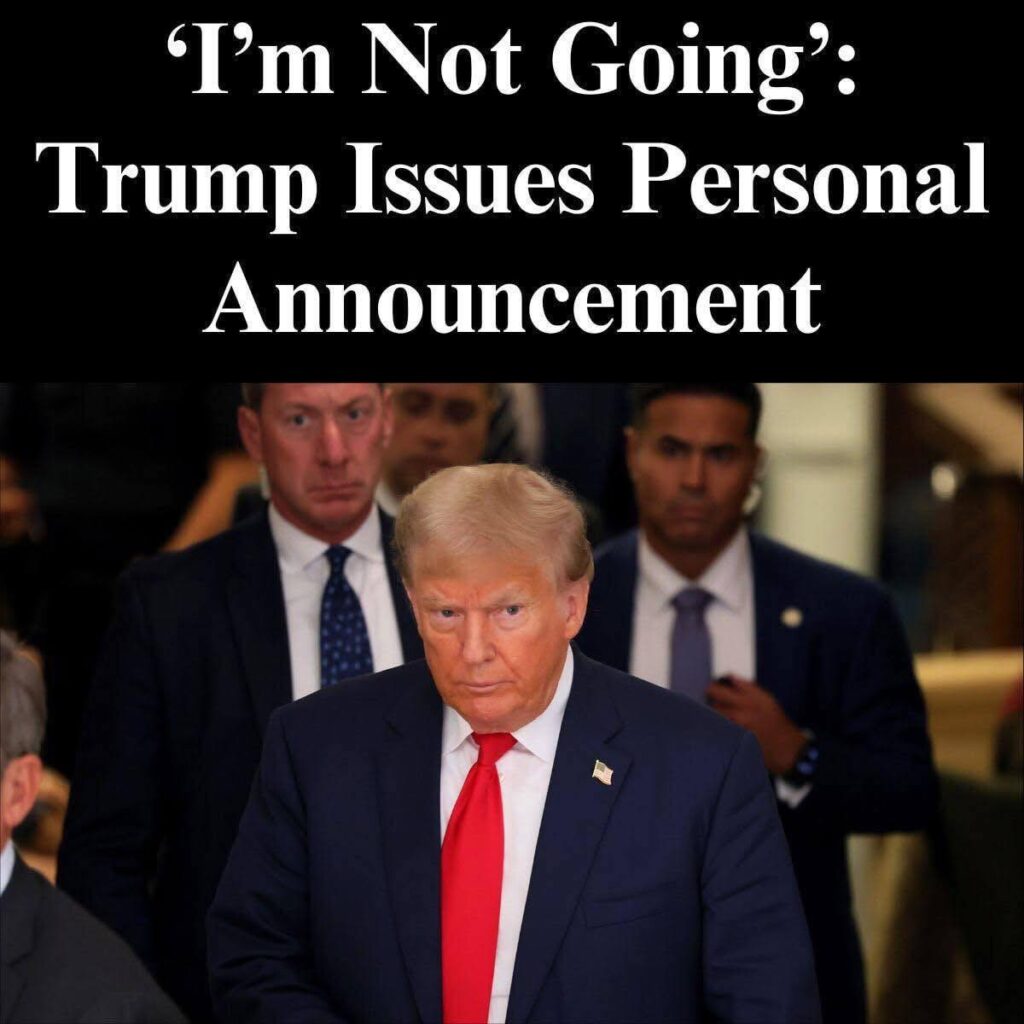
President Donald Trump has confirmed that he will not attend this year’s White House Correspondents’ Dinner, marking the fifth time he has chosen to skip the event — and few are surprised.
The dinner, scheduled for April 26, has long been billed as a lighthearted evening of jokes and speeches celebrating the relationship between the press and the presidency. But in the Trump era, it’s become a symbol of something far different: the growing divide between a populist White House and a media establishment that has spent years trying to tear it down.
A Tradition Trump Refuses to Play Along With
Trump skipped every Correspondents’ Dinner during his first term, breaking with decades of presidential tradition. While his predecessors saw the annual event as a friendly roast, Trump viewed it as a stage for bias, mockery, and double standards.
Instead of sitting through comedians’ anti-Trump monologues or politically charged jabs, Trump created his own alternative — the now-famous “Fake News Awards.” The awards highlighted the most misleading, inaccurate, and outright false reports the media published about his administration.
Those counter-events became viral sensations and reinforced Trump’s message that mainstream journalism had abandoned fairness for activism.
His decision to once again sit out this year’s dinner underscores that little has changed.
“Why would I attend an event hosted by people who spend 365 days a year lying about me?” Trump reportedly told aides. “It’s not a celebration of journalism — it’s a celebration of bias.”
Clash Between the White House and the Press
The relationship between Trump’s administration and the White House Correspondents’ Association (WHCA) remains tense. Earlier this year, Press Secretary Karoline Leavitt announced that the administration would assume direct control over the press pool rotation, which determines which reporters can accompany the president on trips or attend restricted events.
That move gave the administration more say over who gets access — a decision that infuriated establishment outlets that have long seen themselves as entitled to special privileges.
The Associated Press was later barred from participating in pool coverage after clashing with the administration over Trump’s proposal to rename the Gulf of Mexico as the “Gulf of America.”
While critics called the decision “unprecedented,” Trump allies said it was simply a correction to years of media manipulation.
“For too long, these reporters have acted like they own the White House press room,” Leavitt said in a recent interview. “This president doesn’t owe access to anyone who refuses to report honestly.”
A History of Hostile Dinners
The White House Correspondents’ Dinner once offered an evening of humor and civility, where journalists and presidents shared laughs despite their political differences. But over the past decade, that spirit has largely disappeared.
The tone shifted sharply in 2011, when then-President Barack Obama used his speech to publicly humiliate Trump, who was sitting in the audience. At the time, Trump was leading calls for Obama to release his birth certificate — and Obama’s mocking remarks reportedly fueled Trump’s determination to one day seek the presidency himself.
Since then, the dinner has only grown more political and more divisive.
In 2018, comedian Michelle Wolf’s speech attacking then-Press Secretary Sarah Huckabee Sanders — comparing her to a villain from The Handmaid’s Tale — drew bipartisan condemnation and marked a turning point for the event’s reputation.
The following year, the WHCA decided not to feature a comedian at all.
But this year, controversy has returned once again.
Another Controversial Comedian Dropped
The 2025 dinner was originally set to feature Amber Ruffin, a comedian and late-night host known for infusing her routines with political activism. However, after public backlash, the WHCA quietly dropped Ruffin from the program.
Ruffin had promised to follow in Michelle Wolf’s footsteps — vowing to “hold this administration accountable” through humor, a phrase critics saw as code for another partisan attack.
Her past statements didn’t help her case. After the 2021 Kyle Rittenhouse verdict, Ruffin delivered an emotional monologue accusing the judge and jury of racism. She later referred to law enforcement as “murderers” and claimed that “white privilege” was “destroying democracy.”
The tipping point reportedly came after The Daily Beast published excerpts from Ruffin’s planned monologue for the Correspondents’ Dinner, in which she referred to the Trump administration as “killers who want to feel human — but don’t deserve to.”
That revelation sparked outrage.
“This year’s @WHCA dinner will be hosted by a second-rate comedian calling the administration ‘murderers,’” a senior Trump official wrote on X. “What kind of journalist attends something like this? What kind of company sponsors it?”
Within days, Ruffin was removed from the lineup — but the damage was done.
The Dinner’s Decline
Critics argue that the Correspondents’ Dinner has become little more than a pep rally for the press, a night where media elites congratulate each other for their coverage — no matter how slanted.
Instead of fostering transparency or trust, the event now serves as a reminder of how far the mainstream press has drifted from ordinary Americans.
“They call it the ‘nerd prom,’” one former Trump advisor noted. “But the only thing nerdy about it is how detached from reality it’s become.”
Sponsorships for the 2025 dinner have reportedly dropped compared to previous years, with several corporations pulling out after complaints about the event’s increasingly partisan tone.
Trump’s decision to skip it — once viewed as a snub — now feels more like a statement of principle.
Leavitt and Other Officials Follow Suit
Press Secretary Karoline Leavitt, one of the youngest ever to hold the position, confirmed she will also skip the dinner. Appearing on former Press Secretary Sean Spicer’s podcast, Leavitt described the event as outdated and self-congratulatory.
“This group was formed because presidents weren’t holding enough press conferences,” she explained. “I don’t think we have that problem under President Trump.”
Leavitt emphasized that Trump has engaged with the media more than most modern presidents — through rallies, interviews, and press gaggles — but on his own terms, not at events where the deck is stacked against him.
A Legacy of Defiance
To Trump’s supporters, his continued boycott of the Correspondents’ Dinner isn’t about avoiding criticism — it’s about refusing to legitimize a system he believes is broken.
Each year he’s skipped the dinner, Trump has instead spent the evening meeting with voters, visiting local communities, or hosting his own media-centered events.
His absence sends a clear message: the president answers to the American people, not to journalists seeking applause from one another.
And despite years of predictions that his no-show would backfire, Trump’s popularity among his base has only grown.
In a political world that often values symbolism over substance, Trump’s refusal to participate in what he calls the “fake news gala” has become symbolic in its own right — a quiet protest against the Washington culture that so many Americans feel excluded from.
A Different Kind of President
The Correspondents’ Dinner was once a stage for presidents to prove they could laugh at themselves. But Trump has chosen a different path — one that aligns with his core message: he’s not part of the club, and he never will be.
And in 2025, with a media landscape more polarized than ever, that stance might resonate more deeply than any punchline.