
My husband filed for divorce the way one files paperwork at the bank.
No therapy. No conversation. No warning.
A thick envelope was delivered to my office reception desk with a yellow sticky note attached:
Please don’t make this difficult.
That was Caleb. Always polite when he wanted control.
He wanted full custody of our ten-year-old daughter, Harper.
In his filing, he described me as unstable, financially irresponsible, emotionally volatile.
He described himself as calm. Reliable. Safe.
And because he wore clean suits and spoke softly, people believed him.
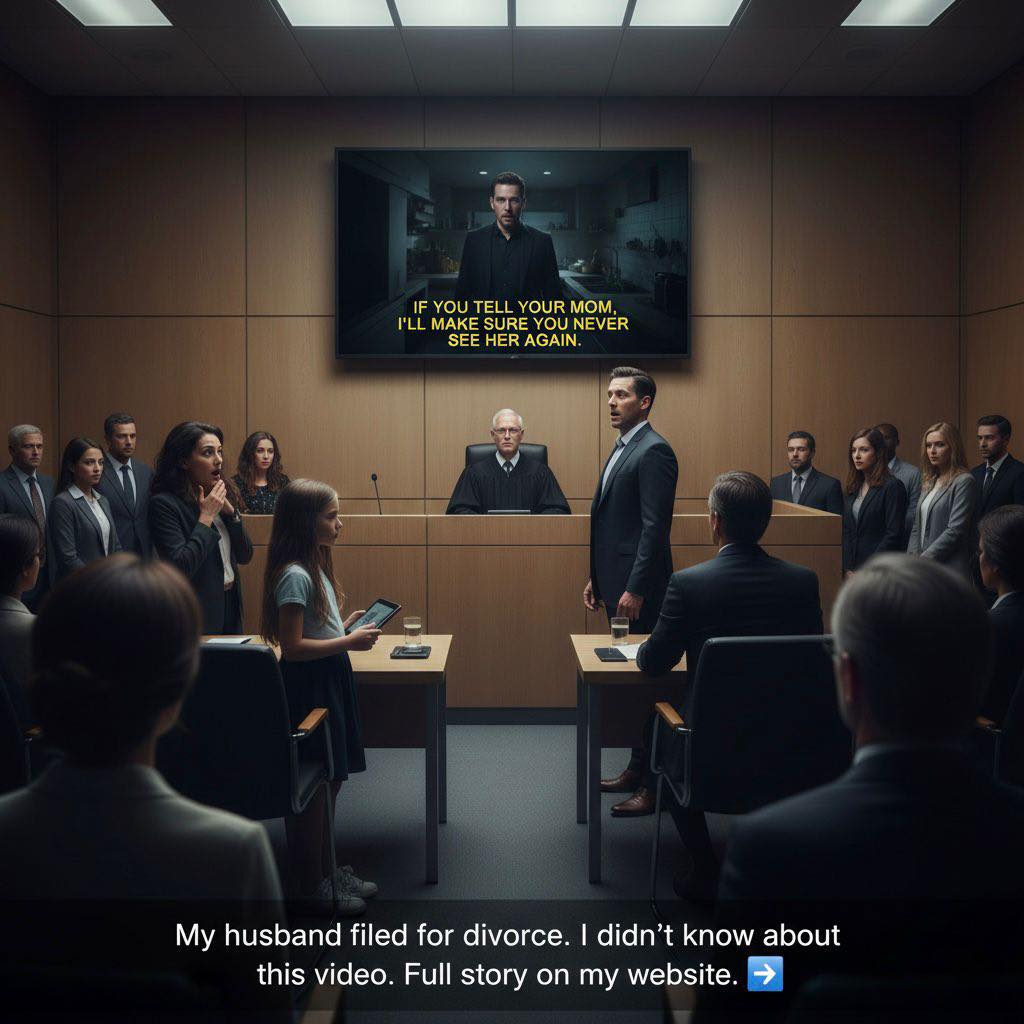
Harper sat beside me in court, her feet not touching the floor, her hands folded far too neatly for a child. Caleb insisted she be present. He said it would “help the judge see reality.”
The reality was a child watching her parents be dissected in public.
When his lawyer finished speaking, Harper raised her hand.
“Your Honor,” she said, her voice shaking but steady,
“Can I show you something Mommy doesn’t know?”
That was the moment everything changed.
The judge did not answer right away.
He studied Harper for a long moment, then glanced at both attorneys.
“What is it you want to show me?” he asked gently.
“A video,” Harper said. “I kept it because I didn’t know who would believe me.”
Caleb stood up so fast his chair scraped loudly against the floor.
“Your Honor, this is highly inappropriate—”
The judge raised one finger.
“Sit down, Mr. Dawson.”
Harper walked forward slowly, holding her tablet with both hands. She did not look at her father. She did not look at me either. She handed it to the bailiff the way someone hands over evidence they’ve been carrying for far too long.
When the screen came on, I expected chaos.
Instead, what followed was quiet.
The video showed our kitchen late at night. The clock on the microwave read 12:47 a.m. Caleb stood near the counter, his voice low, controlled.
“You’re smart,” he said to someone off-camera. “So you understand why Mommy can’t know.”
There was a pause.
“If you tell her,” he continued calmly, “I’ll make sure the judge believes you don’t want to live with her anymore.”
Someone behind me gasped.
The video ended.
Caleb didn’t move. He didn’t speak. He simply stared at the screen as if it had betrayed him.
The judge called a recess.
But the story didn’t end in that courtroom.
That was only the beginning.
WHAT THE COURT NEVER SAW
Three weeks later, after temporary custody was granted to me, Harper still didn’t sleep through the night. She woke at exactly 1:00 a.m. every morning, walking silently to my room and standing beside my bed.
One night, I asked her why.
She hesitated, then whispered,
“That’s when Dad used to check.”
“Check what?” I asked.
“Check if I was asleep,” she said. “If I wasn’t, he’d sit on my bed and talk.”
“What did he talk about?”
Harper stared at the floor.
“Adult things,” she said. “Money. You. Judges. How people choose who they believe.”
That was when I realized something important.
The video hadn’t been a single moment of cruelty.
It had been a system.
THE BOX IN THE CLOSET
A month later, while packing up the last of Caleb’s things, Harper brought me a shoebox she had hidden behind winter coats.
Inside were notes.
Not drawings. Not schoolwork.
Notes.
Dates. Times. Sentences written carefully in pencil.
Dad says calm people win.
Dad says crying looks guilty.
Dad says I have to help him or Mommy will lose.
At the bottom of the box was a second device — an old phone I didn’t recognize.
On it were recordings. Not dramatic. Not loud.
Just patterns.
Caleb rehearsing conversations.
Caleb explaining how to answer questions.
Caleb practicing kindness the way one practices a performance.
That was the mystery no one wanted to name:
Some people don’t explode.
They engineer.
THE FINAL HEARING
At the final custody hearing, the judge didn’t look angry.
He looked tired.
“Mr. Dawson,” he said, “this court has reviewed extensive material. Not abuse in the traditional sense. Something far more difficult to identify.”
Caleb smiled faintly.
“Influence,” the judge continued. “Psychological positioning. Teaching a child how to disappear emotionally.”
He paused.
“You did not raise your voice. You did not strike your child. You did something worse.”
The judge granted permanent sole custody to me.
Supervised visitation only.
Mandatory psychological evaluation.
As Caleb was escorted out, he finally looked at Harper.
“You were supposed to help me,” he said.
Harper answered quietly,
“I did. I helped the truth.”
WHY I’M TELLING THIS NOW
People think danger announces itself.
It doesn’t.
Sometimes it whispers.
Sometimes it smiles.
Sometimes it teaches children how to stay quiet so adults can stay comfortable.
If you are reading this and something feels familiar — trust that feeling.
Children don’t invent fear.
They learn it.
And sometimes, they save it…
until someone is finally ready to listen.