
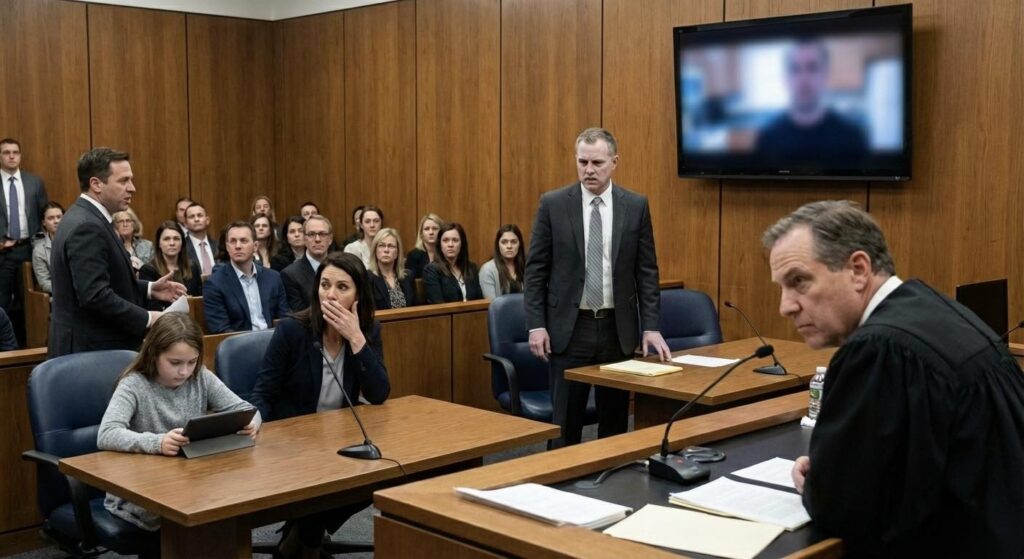
The room erupted—but not with noise. With shock.
The judge’s jaw tightened. Caleb’s lawyer slowly sat back down, color draining from her face. My knees nearly gave out. I had never seen that video. I had never heard that threat. And suddenly every night Harper had clung to me, every unexplained stomachache, every time she flinched when Caleb raised his voice—it all made sense.
The video didn’t stop there.
The next clip showed Harper sitting at the kitchen table, her voice small.
“Daddy, can I call Mommy?”
Caleb leaned into the frame, his smile gone. “Not until you learn who the problem is.”
Then the screen went black.
A sound escaped me—half sob, half gasp. I tried to stand, but my lawyer gently pressed me back into the chair. Across the room, Caleb was shaking his head over and over, whispering, “That’s out of context. She doesn’t understand.”
The judge stood.
“I think,” he said slowly, “we understand perfectly.”
He ordered an immediate recess. Emergency custody review. A child advocate. A forensic evaluation. Caleb wasn’t allowed to come near Harper—not that day, not until further notice. As the bailiff guided him out, Harper finally looked at me. Really looked at me. And for the first time in months, she smiled through tears and mouthed, I’m sorry, Mommy.
That night, as I tucked her into bed at my sister’s house, Harper held my hand and whispered,
“He said no one would believe me because I’m just a kid.”
She was wrong.
Because the next morning, the judge called us back into court—and this time, he had questions Caleb couldn’t answer.
The courtroom felt different the next morning.
Heavier. Colder. Like the truth had finally settled into the walls.
Caleb sat at the opposite table, no clean confidence left. His suit was wrinkled, his leg bouncing uncontrollably. He wouldn’t look at Harper. Not once. She sat beside me this time, her small hand gripping mine like an anchor.
The judge entered and didn’t waste a second.
“Mr. Dawson,” he said, folding his hands on the bench, “children do not fabricate fear like that.”
Caleb’s lawyer stood, clearly scrambling. “Your Honor, my client maintains that the video was taken out of context—”
“Enough,” the judge interrupted sharply. “I reviewed all the files last night.”
My heart skipped.
He turned to me. “Ms. Dawson, did you ever instruct your daughter to record her father?”
“No, Your Honor,” I said, my voice shaking. “I didn’t even know the videos existed.”
The judge nodded, then looked directly at Caleb.
“Did you threaten your child to prevent her from contacting her mother?”
Caleb opened his mouth. Closed it. Opened it again.
“I was trying to maintain order,” he finally said. “She was confused. Her mother is… emotional.”
Harper flinched.
That was it.
The judge’s voice hardened. “What you call ‘order’ is coercion. What you did is psychological abuse.”
A murmur rippled through the courtroom.
“I am granting temporary sole physical and legal custody to Ms. Dawson, effective immediately,” the judge continued. “Mr. Dawson’s visitation is suspended pending a full psychological evaluation and supervised contact—if deemed appropriate.”
I felt Harper collapse into me, sobbing. I held her and cried too, silently, because for the first time in a year, we were safe.
But Caleb wasn’t done.
He stood up abruptly. “You’re making a mistake,” he snapped, his calm mask completely gone. “She’s turning my daughter against me.”
The judge didn’t even raise his voice.
“No, Mr. Dawson,” he said. “You did that yourself.”
Security stepped forward.
As Caleb was escorted out, he finally looked at Harper. His eyes weren’t angry. They were empty.
That afternoon, the child advocate spoke privately with Harper. When she came back, she looked lighter—like a backpack had been taken off her shoulders.
“She thought she was protecting you,” the advocate told me quietly. “She thought if she stayed quiet, you’d be safe.”
That night, Harper asked me something I’ll never forget.
“Mommy… am I in trouble?”
I knelt in front of her, holding her face in my hands.
“No, baby,” I said. “You’re a hero.”
But what we didn’t know yet…
was that Caleb had one more move planned.
I thought the worst was over.
I was wrong.
Three days after the custody ruling, my phone rang at 6:12 a.m. Unknown number. My stomach dropped before I even answered.
“Ms. Dawson,” a calm female voice said, “this is Child Protective Services. We need to speak with you immediately.”
I sat straight up. Harper was still asleep beside me, her hair fanned across the pillow, finally peaceful.
“There has been an allegation,” the woman continued, “that you are emotionally manipulative and coaching your daughter to fabricate abuse.”
The room started spinning.
I knew.
I didn’t need them to say his name.
Caleb.
By noon, a social worker was in my living room, clipboard in hand, eyes observant but not unkind. She asked about my work hours, my finances, my mental health. She asked Harper—gently—if anyone had told her what to say in court.
Harper looked at her, steady and calm.
“No,” she said. “I told the truth because I was scared.”
Then she did something that made the social worker pause.
She stood up, walked to her backpack, and pulled out a folded piece of paper.
“I wrote it down,” Harper said softly. “So I wouldn’t forget.”
Inside were dates. Times. Short sentences written in careful, uneven handwriting:
Dad said Mom would disappear.
Dad said judges don’t listen to kids.
Dad said this is our secret.
The social worker exhaled slowly.
That afternoon, she called her supervisor.
By evening, I received another call—this one from my lawyer, her voice tight with urgency.
“Caleb filed an emergency motion,” she said. “He’s asking the court to remove Harper from both of you and place her in temporary foster care.”
I nearly dropped the phone.
Foster care.
He would rather our daughter be taken by strangers than stay with me.
We were back in court the next morning.
Caleb looked wild now. Desperate. He claimed I had “poisoned” Harper against him. That the videos were “misinterpreted.” That I was manipulating the system.
The judge listened. Quietly. Patiently.
Then he asked one question.
“Mr. Dawson,” he said, “are you aware that filing knowingly false CPS reports constitutes abuse of process?”
Caleb froze.
Because CPS had already submitted their preliminary findings.
No evidence against me.
Strong indicators of emotional coercion by the father.
Documented intimidation of a minor.
The judge removed his glasses.
“This court does not tolerate retaliation against a child for telling the truth,” he said.
Then he delivered the words that changed everything.
“Mr. Dawson, your parental rights are hereby terminated pending criminal investigation.”
The room went silent.
Harper squeezed my hand.
As deputies escorted Caleb away, he didn’t fight. He didn’t argue.
He just said one thing as he passed us:
“She’ll hate you for this.”
Harper looked up at me, eyes clear.
“No,” she said quietly. “I won’t.”
Because sometimes…
the smallest voice is the strongest in the room.