
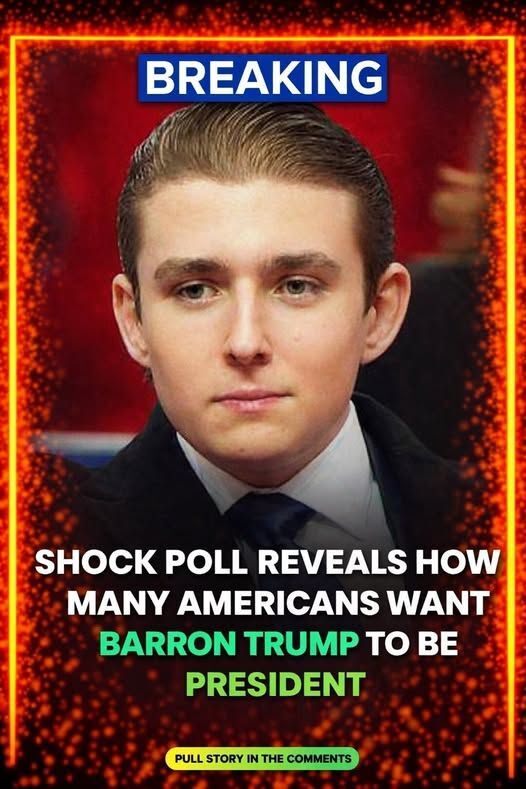
It started with a number—but quickly turned into something much bigger. A recent poll revealed that a surprising segment of Americans might support Barron Trump as a potential future president, and within minutes, reactions exploded across social media, news outlets, and private conversations. For some, it was intriguing, almost aspirational. For others, it felt premature, unnecessary, or even intrusive. What was initially a set of statistics rapidly transformed into a public debate, raising questions not only about Barron himself but about the broader cultural fascination with political dynasties.
Barron Trump: The Private Figure in the Public Eye
Barron Trump, now in his late teens, has lived a life unlike most teenagers. Born into one of the most prominent families in the United States, his upbringing has been defined by extraordinary circumstances: the White House, national attention, and media scrutiny. Yet, despite these conditions, Barron has remained notably private. Unlike many children of political leaders who engage directly with public life, Barron has generally avoided speaking publicly, staying out of political commentary and limiting his appearances to family events or official ceremonies.
This privacy has only added to the fascination. People are curious about him precisely because they know so little. In many ways, his image is a blank canvas onto which the public projects expectations, hopes, and anxieties about political futures.
The Poll That Sparked Debate
The poll itself was straightforward: respondents were asked whether they would consider supporting Barron Trump in a future presidential election. The numbers, though surprising to many, revealed that a notable minority expressed interest.
Immediately, social media users began reacting. Hashtags emerged, opinion pieces were written, and news organizations ran stories. Some reactions were positive, citing his family background, perceived intelligence, or personal charm. Others were skeptical, noting that Barron is still a teenager and questioning whether it is appropriate to project political ambitions onto someone so young.
This dichotomy of reactions demonstrates a broader truth: people respond not just to the subject of the poll, but to the ideas and assumptions they hold about politics, youth, and family legacy.
Public Curiosity vs. Privacy
One of the central tensions highlighted by this poll is the balance between public curiosity and personal privacy. Barron Trump has largely stayed out of the spotlight, yet a single poll has thrust him into the center of public conversation. This raises critical questions:
- Should children of public figures be subject to political speculation?
- What responsibilities do media outlets have when reporting on underage individuals?
- How does this attention impact a young person’s psychological development?
Experts in child psychology caution against excessive public scrutiny of minors, noting that such exposure can create long-term stress, identity confusion, and unwanted pressure. The American Academy of Pediatrics emphasizes that children of public figures require additional boundaries to safeguard mental health.
Historical Context: Political Dynasties and Their Children
Barron Trump is not the first child of a political leader to attract public attention. Historical examples include:
- John F. Kennedy Jr., who grew up under media scrutiny and eventually became a public figure in his own right.
- Chelsea Clinton, who navigated a complex balance of privacy and visibility during and after her father’s presidency.
- Amy Carter, daughter of Jimmy Carter, whose childhood in the White House was closely followed by the media.
These cases highlight a consistent theme: children of political leaders are often seen as extensions of their family legacy, and the public projects onto them expectations that may be unfair or unrealistic.
Social Media Amplification
In today’s digital landscape, social media accelerates these dynamics. A single tweet, post, or poll can become viral within minutes, reaching millions and shaping narratives instantly. In the case of Barron Trump:
- Platforms like Twitter, Instagram, and TikTok magnified the poll results.
- Users debated his potential candidacy, often without considering his age or personal choice.
- Memes, commentary, and speculation became widespread, highlighting both fascination and criticism.
This rapid amplification underscores a broader challenge for public figures and their families: managing visibility in an environment where information—and opinion—travels faster than facts.
Public Reactions: Support, Skepticism, and Criticism
The responses to the poll can be grouped broadly into three categories:
- Supportive: Some individuals expressed enthusiasm for the idea, citing Barron’s family heritage, potential leadership qualities, or desire for continuity in political values.
- Skeptical: Others questioned the premise entirely, noting that he is still a minor, that political ambition should be self-directed, and that projecting aspirations onto him is premature.
- Critical: A vocal segment argued that such polls are inappropriate, exploitative, or potentially damaging, stressing that minors should not be the subject of political speculation.
The diversity of reactions illustrates the complexity of public discourse, especially in the context of children and politics.
Media Responsibility and Ethical Reporting
News outlets covering the poll faced the challenge of reporting responsibly. Ethical considerations included:
- Avoiding sensationalism or implying that Barron is “running” for office
- Emphasizing his age and lack of public statements regarding political ambitions
- Providing context about historical examples and expert commentary on privacy
Responsible reporting is essential to prevent the spread of misinformation, undue pressure, or public misunderstanding.
The Psychological Perspective
Child development experts emphasize that public speculation about political futures can be stressful for adolescents. Key concerns include:
- Identity formation: Adolescents need space to explore personal interests without external pressure.
- Mental health: Unwanted public attention can exacerbate anxiety or depression.
- Autonomy: Minors should have the freedom to decide their future paths without imposed expectations.
Dr. Susan Fields, a child psychologist, explains, “While public curiosity is understandable, projecting political roles onto someone under 18 can be psychologically burdensome. It’s important to remember that Barron’s identity is still forming independently of his family legacy.”
Lessons for the Public
This situation offers broader lessons for society:
- Recognize boundaries: Minors deserve privacy, regardless of family status.
- Question the intent of polls: Not all public surveys reflect meaningful political trends.
- Separate speculation from fact: Curiosity is natural, but media should avoid conflating polls with actionable conclusions.
- Understand developmental needs: Adolescents should be allowed to grow and explore without external pressure.
Broader Political Implications
While Barron Trump himself is not a candidate, the poll reflects ongoing public interest in political dynasties and intergenerational leadership. Americans have long debated the role of family legacy in politics, as seen in discussions about the Bush family, the Kennedys, and the Clintons.
Such conversations reveal tensions between democratic ideals of merit and the allure of continuity in governance. They also highlight how public fascination can sometimes overshadow the personal rights of individuals, especially minors.
Conclusion: Balancing Curiosity and Responsibility
The reaction to the poll about Barron Trump underscores a key reality of modern public life: curiosity can quickly become scrutiny, speculation can evolve into pressure, and statistics can ignite nationwide debates. For minors in prominent families, these dynamics are amplified.
Ultimately, this moment serves as a reminder for media, public figures, and citizens alike: interest must be balanced with responsibility. Young individuals, no matter their family background, deserve privacy, space for personal development, and freedom from premature expectations.
Whether the poll is seen as intriguing, frustrating, or shocking, its larger lesson is clear: responsibility and empathy must guide public discourse, especially when the subject is a minor.