
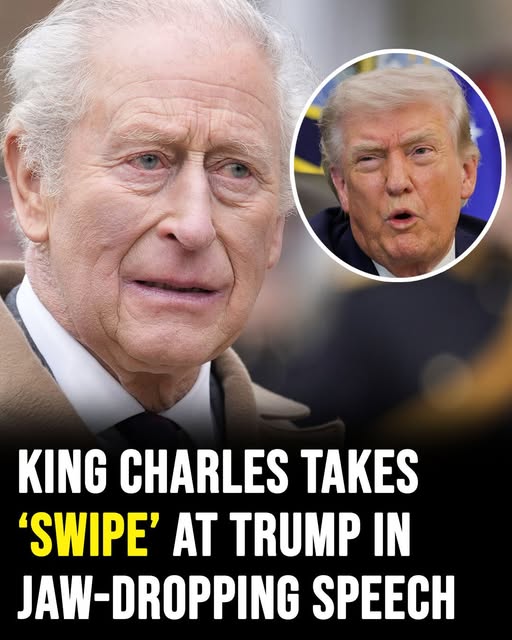
A recent speech by King Charles III has sent shockwaves through the global landscape, igniting a flurry of conjecture that the British monarch has finally broken his customary quiet. The hallowed corridors of Buckingham Palace have seen centuries of diplomatic tightrope walking. The event, which was a commemoration of his mother, the late Queen Elizabeth II, on what would have been her 100th birthday, carried great emotional significance. The people heard a well prepared speech that many political observers feel included a razor-sharp hidden agenda aimed directly at the United States and specifically at Donald Trump, despite their expectations of a conventional homage to the longest-reigning monarch in British history.
The speech opened with the dignity and respect befitting a monarch paying tribute to a legend. Charles talked extensively on his mother’s steadfast sense of responsibility, her composure in the face of world turmoil, and her exceptional capacity to relate to people of all ages and backgrounds. He depicted a woman whose life served as a source of stability for almost a century. But as the King turned from remembering the past to discussing the current status of the globe, the attitude in the audience clearly changed. The media world was ignited by a single, eerily moving line.
In what seemed to be a general observation on the passing of time, King Charles said that his mother would have been terribly worried by the current era—the particular, terrible times we live in today. This would have sounded like a nostalgic comment about the rapid advancement of technology or the decline of traditional values to the uninformed listener. However, it was a coded message of great value to those who study the subtleties of royal communication. The King is prohibited by the constitution from directly criticizing foreign leaders or promoting candidates due to the monarchy’s stringent code of political neutrality. Therefore, the most urgent issues of the day quickly fill the void left by a monarch’s usage of phrases like “troubled deeply” in relation to current affairs.
Experts in international relations and royal pundits were quick to analyze the subtext. Prominent observers like Kinsey Schofield noted that the King’s word choice was anything but coincidental. The world is today dealing with a return of isolationism, changing alliances, and an unstable political environment in the West that frequently revolves on the divisive figure of Donald Trump. Charles cleverly put a shadow over contemporary populist groups and their leaders by implying that Queen Elizabeth II, a woman who experienced World War II, the Cold War, and the fall of the Berlin Wall, would find the current situation particularly unsettling.
The story is made more difficult by the timing of this “swipe.” The speech was given at a time when the Royal Family and the British government were getting ready for a crucial diplomatic trip to the United States. In order to strengthen the Special Relationship between the two countries, King Charles and Queen Camilla are anticipated to travel across the Atlantic for a number of high-profile meetings with American leadership. A daring new era for the monarchy is suggested by the King’s issuance of such a laden statement on the eve of this tour. It suggests a King who is unwilling to watch helplessly as the world order his mother helped uphold for seventy years starts to erode, even while he still respects the limits of his position.
The speech also emphasizes the underlying conflict between the British Crown and the changing political landscape in the United States. The relationship between Donald Trump and the British royals is known to be complicated. His policies and rhetoric regularly ran counter to the environmental and internationalist causes that King Charles has supported for decades, despite his numerous expressions of affection for the Queen. Charles is utilizing the most potent weapon in the royal arsenal—the moral authority of the late Queen—by using his mother’s memory to convey worry for the present. He is portraying the current political turmoil as a break from the very steadiness and fortitude that Elizabeth II embodied, rather than merely as a policy issue.
Opponents of this view contend that the King’s remarks were merely those of a bereaved son considering the lessons learned from a deceased dad. They contend that royal speeches are intended to be inkblot tests, meaning that anyone can project their own political prejudices onto them due to their ambiguity. These doubters contend that rather than naming a particular political figure, Charles was alluding to the development of artificial intelligence, climate change, or general social disintegration. However, the idea of a neutral term has essentially vanished in the hyperconnected and closely watched world of contemporary media. Every word a head of state says is evaluated in light of the current news, and given the current situation, the possibility of a Trump government returning and its ramifications for the UK are the biggest headlines.
The King’s speech centered on the ideas of hope and continuity. He reaffirmed his mother’s long-held conviction that a country’s strength lies in its capacity to maintain composure and move forward in the face of adversity. However, he produced a strong rhetorical tension by contrasting that hope with the “troubling” aspect of the present. He appeared to be asking the audience, as well as the entire world, if we are upholding the decorum and leadership standards that the twentieth century required. It was an appeal to revert to a more steady, predictable system of government that honors the established institutions that the Queen devoted her life to defending.
The palace has been remarkably silence as the rumors continue to circulate, declining to explain or disavow any part of the address. In and of itself, this quiet serves as confirmation. Without the King having to bear the weight of a formal political pronouncement, it enables the message to resonate in the public awareness. It is a master class in soft power, a means for the monarchy to shape the discourse without ever entering the political arena.
The effect is the same whether the line was a deliberate attack on a particular American political movement or a general lament for a changing world. With just one sentence, King Charles III has demonstrated his ability to control the world’s narrative. The world will be observing every handshake and glance as he gets ready to meet with American officials, hoping to learn more about the King’s true feelings toward the future of the West. Charles has demonstrated that a whisper from a King can be louder than a shout from a podium in an era of loud, brazen politics, reminding us all that even if the Queen is no longer with us, her legacy is still a potent force in the hands of her son. The King has just penned the first line of a new and more complex chapter in the Special Relationship.