
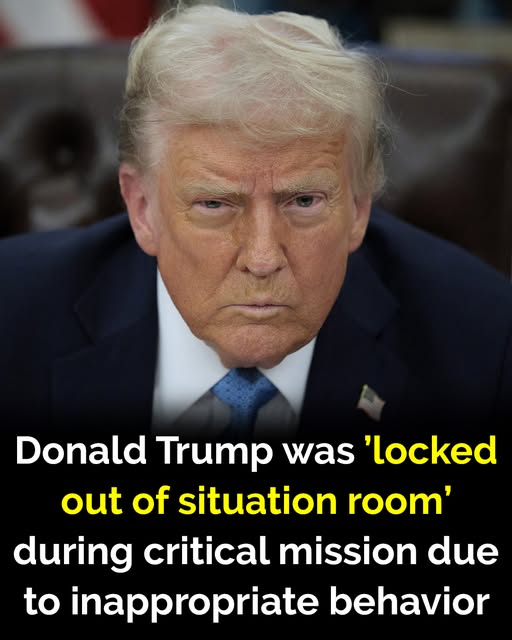
Internal politics seldom compromise the sanctity of the White House Situation Room, but a startling account has surfaced describing an instance in which the Commander-in-Chief was allegedly ignored during a military crisis. An unprecedented breakdown in executive etiquette occurred during a high-stakes search and rescue mission in enemy territory in early April 2026, as tensions around the world reached a fever pitch. A different kind of fight was purportedly taking place within the West Wing, a struggle over temperament, information flow, and the stability of leadership during a life-or-death operation, as the world watched the escalating conflict between the United States and Iran.
An F-15E Strike Eagle crashed over southwest Iran on April 3, 2026, during ongoing military operations, sparking the incident. A simple expedition turned into a global nightmare in an instant. One airman was swiftly retrieved by tactical units after the two-person crew was evacuated into difficult, disputed territory, but the other was still unaccounted for. The US military was in a frantic race against time for more than twenty-four hours. In an area where the possibility of complete conflict was already simmering, the missing pilot was a ticking clock. The urgency was evident within Washington’s nerve center, but those familiar with the events claim that the West Wing climate was more marked by explosive volatility than by clinical accuracy.
According to Wall Street Journal reports, Donald Trump reacted with intense rage as the seriousness of the situation became apparent. The President reportedly went on an hours-long diatribe, yelling at senior aides and expressing visceral frustration after discovering that an American service member was missing in Iranian territory. Witnesses portrayed a President who was focused with the eerie shadow of historical precedent in addition to the pilot’s tactical safety. He apparently brought up the 1979 Iran hostage situation alarmingly frequently, pointing out how Jimmy Carter’s presidency had been severely damaged by that particular failure. The missing airman was more than simply a soldier to Trump; he was a possible political disaster that might define his legacy.
The White House became physically divided as the search and rescue effort entered its most crucial stage. Senior officials, including as Chief of Staff Susie Wiles and Vice President JD Vance, were positioned inside the Situation Room, where they belonged, keeping an eye on live feeds and intelligence streams as they came in from the field. The US President, however, was noticeably missing from the table. According to sources, senior aides quietly and strategically decided to keep Trump out of the room. One senior official’s explanation was as direct as it was contentious: there were long-standing worries that the President’s growing impatience and erratic temperament would sabotage the delicate information flow and interfere with the commanders’ operational focus on the ground.
Trump was allegedly kept at a distance during a kinetic operation, as opposed to the customary ongoing briefing given to a sitting president. He received updates over the phone at strategic intervals, a communication mechanism that successfully filtered the mission’s raw, disorganized data before it got to the Oval Office. This shielding raised serious concerns about who was actually in charge during the mission’s most trying times because it was a drastic deviation from customary presidential protocol. Press Secretary Karoline Leavitt’s official White House reaction tried to present a far more harmonious image. She maintained that the President was “steady” and “fully informed,” describing the decision-making process as a regular delegation of responsibilities rather than an exclusion by force.
The U.S. military and intelligence apparatus maintained its professionalism in the face of internal conflict. The operation culminated on April 4. The missing airman was found and taken out by U.S. forces after more than a day of what officials described as a “needle in a haystack” search. The Central Intelligence Agency provided the “advanced intelligence capabilities” required to locate a human person concealed in some of the most harsh and dangerous terrain on earth, making the rescue feasible through a masterclass in contemporary espionage. In stark contrast to the alleged disarray at the highest echelons of government, the pilot’s safe return was a win for the Special Operations community.
The rescue, however, had little effect on the rhetoric coming from the White House. Trump used combative language against the Iranian infrastructure even during the pilot’s debriefing. He issued a warning that the United States was ready to take action that would cause “widespread destruction” if diplomatic talks failed to result in a satisfactory agreement. International observers were immediately alarmed by the President’s comments following a successful rescue because they believed that the President’s personal grievances were interfering with the United States’ strategic goals. The prospect of future peace negotiations is in a dangerous state of uncertainty as Iranian leaders, who are never one to back down from a verbal battle, indicated their own preparedness for escalation.
A precarious ceasefire is about to expire, and the President has made it clear that he is not interested in extending the grace period. A picture of a president at a crossroads is painted by this strong posture and the reports of his absence from the Situation Room. A Commander-in-Chief on one side sees military actions from the perspective of historical grievance and political survival. The military leadership and professional staff, on the other hand, felt compelled to circumvent the president in this case in order to guarantee operational success.
This incident has many more ramifications than just one downed airplane. It casts doubt on the conventional wisdom on the American chain of command. It indicates a deep degree of internal mistrust if those closest to the president feel that his presence is a liability during a crisis. Even if the mission was a tactical success—no lives were lost during the extraction, and the pilot returned home—it is impossible to overlook the procedural irregularities. When it comes to high-stakes geopolitics, the public frequently only cares about the outcome, but individuals in positions of authority value the process above all else.
Washington is forced to confront the reality of an executive branch that seems to be functioning in silos as the rescue effort comes to an end. The tale of April 3 is now about the mechanics of power in a volatile modern era rather than just a pilot in the desert. It serves as a reminder that the most perilous times in a president’s life frequently take place behind closed doors, in the quiet places where choices about who gets to be present when everything is at stake are made. The questions about Donald Trump’s leadership style and the extraordinary steps taken by his own staff to manage it are just getting started, but the airman is back home. The Situation Room’s “locked door” could end up being the most memorable representation of a presidency characterized by its disregard for the law in this developing story.