
Although it hasn’t always been empty, our home has always had a deep silence. Leo, my twelve-year-old son, has carried a quiet type of resilience that most adults never find since my husband’s death three years ago. He doesn’t complain or say much, but he feels the weight of the world with such intensity that he frequently stays on the outskirts of his peers’ noisy, hectic existence. That is, until everything changed during the school hiking trip.
I hadn’t seen a spark in his eyes in years when it all began. When Leo got home, he dropped his backpack and told me that his best friend Sam wanted to go on the forthcoming camping trip for sixth graders, but the school had decided it was not possible. The rough mountain trails were viewed as a liability because Sam had been in a wheelchair since birth. Sam posed a logistical challenge to the school administration. Sam was a friend who had been abandoned by Leo. At the time, Leo didn’t dispute with the teachers; instead, he just listened, his mind already racing with a resolve I wasn’t yet aware of.
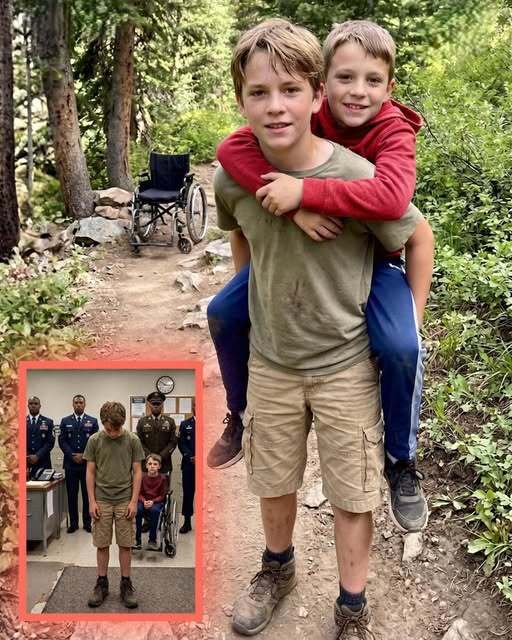
I anticipated seeing a weary but content youngster on Saturday afternoon when the buses pulled back into the school parking lot. Rather, I observed a little child who appeared to have experienced combat. Leo got off the bus last. As he stepped onto the tarmac, his pants were covered in dried dirt, his shirt was covered in perspiration, and his legs were clearly trembling. He had a look of deep, worn-out serenity despite his pale complexion and rapid breathing. A parent named Jill stopped me before I could even get to him. Her eyes were wide with a mixture of admiration and incredulity. Leo had taken Sam, she informed me, while the rest of the class took the simple routes. In addition to pushing him, Leo had lifted Sam onto his back when the terrain changed to loose rock and steep inclines where wheels couldn’t traverse.
For six exhausting miles, he had carried his closest friend. Leo just tightened his hold and muttered, “I’ve got you,” each time Sam pleaded with him to stop or the teachers called for them to return and wait at the campsite. Together, we are going to finish this.
The consequences were felt right away. The class teacher, Mr. Dunn, came up to us in the parking lot, his face flushed with rage. He gave me a lecture about “protocol” and “safety violations,” accusing Leo of endangering the boys by going off the designated route. Instead of describing the event as a miracle of friendship, he described it as a signal of shame. I expressed regret for the anxiety I had created, but on the inside, I was so proud that I nearly started crying.
The scenario worsened the following morning. Principal Harris called me in a panic. She told me I had to hurry to the school right away because “men in uniforms” were there expressly looking for Leo, and her voice was shaking. My heart fell. I thought the state was taking formal disciplinary action or that the school was filing charges. With my hands white-knuckled on the driving wheel, I drove like a woman possessed.
I froze when I stormed into the principal’s office. Wearing full military fatigues, five soldiers stood in a row. They were tall, imposing, and had stone faces. Leo was already there, crouched in a chair and looking completely scared. When he saw me, tears welled up in his eyes. Frantically apologizing, he begged them not to “take him away” and vowed never to defy commands again. A youngster who had done the most admirable thing imaginable now thought he was a criminal because it was a devastating sight. Smugly standing in the corner, Mr. Dunn even added that Leo ought to have considered the repercussions before acting heroically.
Then Lieutenant Carlson, the tallest soldier, came forward. His voice was surprisingly mild, yet his harsh expression remained unwavering. He assured my kid that they weren’t there to punish him while bending down to meet his eyes. He clarified that they had learned about Leo’s behavior via a very particular method.
Sally, Sam’s mother, entered through the open door. Despite her tears, she had a smile on her face. She clarified that Mark, Sam’s father, was a general who had lost his life in battle many years prior. Prior to his death, Mark was the only one who could take Sam into the wilderness and carry him on his back so the youngster could see the world outside the pavement. Sam had lived a life of limits since Mark’s death, seeing his friends go places he was unable to follow.
Sam was changed when he got back from the hike, in addition to being exhausted. He described how the valley seemed from the tallest peak, the wind at the top, and the scent of the pine needles—sights he believed he would never witness in his lifetime. He told his mother that Leo had refused to let him go, saying, “As long as we are friends, I will never leave you behind,” even though his legs were weakening and his skin was bruised from the weight.
The military men were there as Mark’s old brothers-in-arms, not to arrest Leo. They had come to fill the void left by a fallen buddy. Lieutenant Carlson made it apparent to the principal and the frowning Mr. Dunn that what they considered a “protocol violation” was the pinnacle of sacrifice and leadership in the military.
The troops declared that they had created a full-ride scholarship fund in Leo’s name in front of the shocked school personnel. All of his dreams, universities, and futures were now fully funded. Then, Captain Reynolds moved forward and affixed a commemorative unit patch—a mark of valor and camaraderie typically reserved for troops in the field—to Leo’s shoulder. Sam’s father would have been pleased to name him a son, he informed Leo.
Overwhelming grace replaced the oppressive tension in the room. After three years of living in the shadow of his own pain, I saw my son rise to his feet. He was no longer just the silent kid in the back of the class. He was a young man who realized that a person’s actual worth is determined by who they are ready to carry when the journey becomes difficult, not by how quickly they can run the course.
Sam was waiting in his wheelchair, surrounded by the other soldiers, as we emerged into the hallway. The two lads locked eyes and shared a secret, unbreakable smile that is only shared by those who have overcome adversity together. Rules and danger were no longer discussed. For a youngster who believed the world was closed off to him, there was only the reality of a somewhat broader world and an enormously greater future for the boy who had the courage to take him there. It dawned on me then that Leo had been busy learning how to alter the world while I had spent years attempting to shield him from it.