
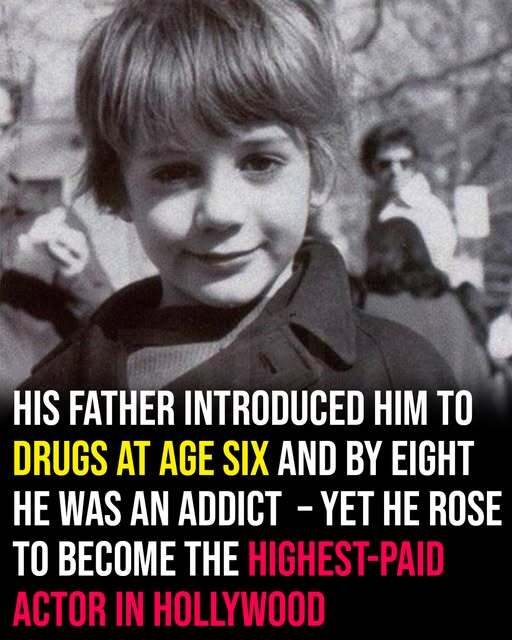
Robert Downey Jr. has dominated the entertainment industry for many years, instantly recognizable across continents and generations. His name is associated with one of the most famous roles in contemporary cinema, enormous box office success, and critical acclaim. However, none of that was assured. In fact, there was a moment when it appeared that his story would fail rather than succeed.
His life was chaotic, precarious, and on the verge of collapse long before the accolades and international exposure.
He was born in 1965 in New York City into a family with a strong artistic heritage. His mother, Elsie Downey, was an actress, and his father, Robert Downey Sr., was an underground filmmaker renowned for his unusual work. From the start, he was surrounded by creativity and dysfunction. He was exposed to situations that no youngster should have to deal with in the same setting that fostered his talent.
He didn’t learn how to act; it was something he developed on the inside. He had previously made an appearance in one of his father’s movies at the age of five. He was taught how to act in front of a camera before most children even knew what one was. His innate ease on TV became evident as he grew older. He received training, participated in acting courses, and acquired a skill set that suggested a bright future.
However, something much more intricate was beginning to take shape behind that first promise.
His father battled addiction, and he exposed his young son to narcotics – a choice that would come back to haunt him. At the time, what appeared to be a thoughtless act turned into the start of a pattern that would follow Robert for many years. It shaped his understanding of connection and escape by obfuscating the distinction between bonding and destruction.
His career started to take off when he entered his adolescence and early twenties. He joined a growing group of young performers in the 1980s who were becoming well-known throughout Hollywood. He became well-known because to movies like Weird Science and Less Than Zero, the latter of which strangely mirrored the precise hardships he was going through off-screen.
From the outside, he appeared to be headed for great success.
However, things were falling apart on the inside.
His private life become more precarious. His well-known connection with Sarah Jessica Parker, who subsequently discussed the challenges of trying to support someone stuck in that cycle, was one of the relationships that were stressed under the weight of addiction. When she could, she provided him with stability, but good intentions don’t readily overcome addiction.
The fissures had become fractures by the mid-1990s.
His name began to make news for all the wrong reasons, including erratic behavior, rehab stays, and arrests. In one instance, he was stopped on suspicion of driving while intoxicated, and officials allegedly discovered a gun and illegal narcotics. Another incident that stunned the public had him wandering into a stranger’s house, becoming lost, and dozing off in their bed.
It was no longer a personal battle.
It was chaotic, public, and spiraling.
It eventually caught up with him in a way that was impossible to ignore. Due to legal issues, he was sentenced to prison, which he subsequently regarded as one of the riskiest and most somber times of his life. That appeared to be the conclusion of the story to many who were observing from the outside. Hollywood doesn’t always allow for second chances, particularly after a string of failures.
His career appeared to be ended at that point.
However, his narrative didn’t finish there.
The early 2000s marked a tipping point. It wasn’t immediate or dramatic. Nothing was resolved at a single moment. Rather, it was a gradual change, one choice at a time.
He was sober by 2003.
Even though that was a huge accomplishment on its own, it was just the start. It takes more than just giving up harmful behaviors to rebuild a life. It calls for perseverance, self-control, and a readiness to confront everything you’ve attempted to avoid.
He started working again, gingerly at first. Smaller jobs, deliberate measures, regaining trust in an industry that had every reason to doubt him. Project by project, he gradually demonstrated his dependability once more. that he could be reliable, deliver, and show up.
His personal life started to stabilize at the same period. He got married again, began strengthening the basis at home, and turned his attention to something he had never completely experienced before: constancy.
But life continued to put him to the test even after that.
Robert was on the opposite side of a situation he was all too familiar with when his oldest son subsequently struggled with addiction. He reacted with an experience-shaped viewpoint rather than denial or distancing. He saw the gravity of that conflict and, more crucially, the potential for victory.
He did not present it as a setback.
He presented it as an opportunity to heal.
Then the role that altered everything appeared.
It wasn’t just another job when he was chosen to play Tony Stark in Iron Man; it was a gamble. He wasn’t the obvious pick at the time for a franchise that would grow to be among the largest in movie history. However, that risk paid off in a way that few could have imagined.
It was an electrifying performance. Unquestionably captivating, charismatic, and multi-layered.
And everything changed in an instant.
His career was not only revitalized by the part, but it also propelled him into uncharted territory. He became a key character in one of the most prosperous series ever made, appearing in movie after movie. At the international box office, his name alone started to carry weight.
He was formerly someone the industry was reluctant to put their trust in.
To one of the world’s highest-paid actors.
There were then awards. Acknowledgment came next. However, it was the contrast rather than merely his accomplishment that made his narrative compelling.
He had been at the bottom.
Prison. Arrests. Addiction.
And without deleting his origins, he had ascended back up, one step at a time.
His journey is unique because of this. It’s hardly a tale of flawlessness or quick salvation. It’s about perseverance. about repeatedly deciding to move on despite the fact that the past does not go away.
His life serves as evidence today that the conclusion need not be determined by the most challenging chapters.
Redemption is a continuous process.
It’s a succession of silent, consistent judgments that are frequently taken in private.
In his instance, the choices went beyond simply reestablishing a profession.
A whole life was rewritten by them.