
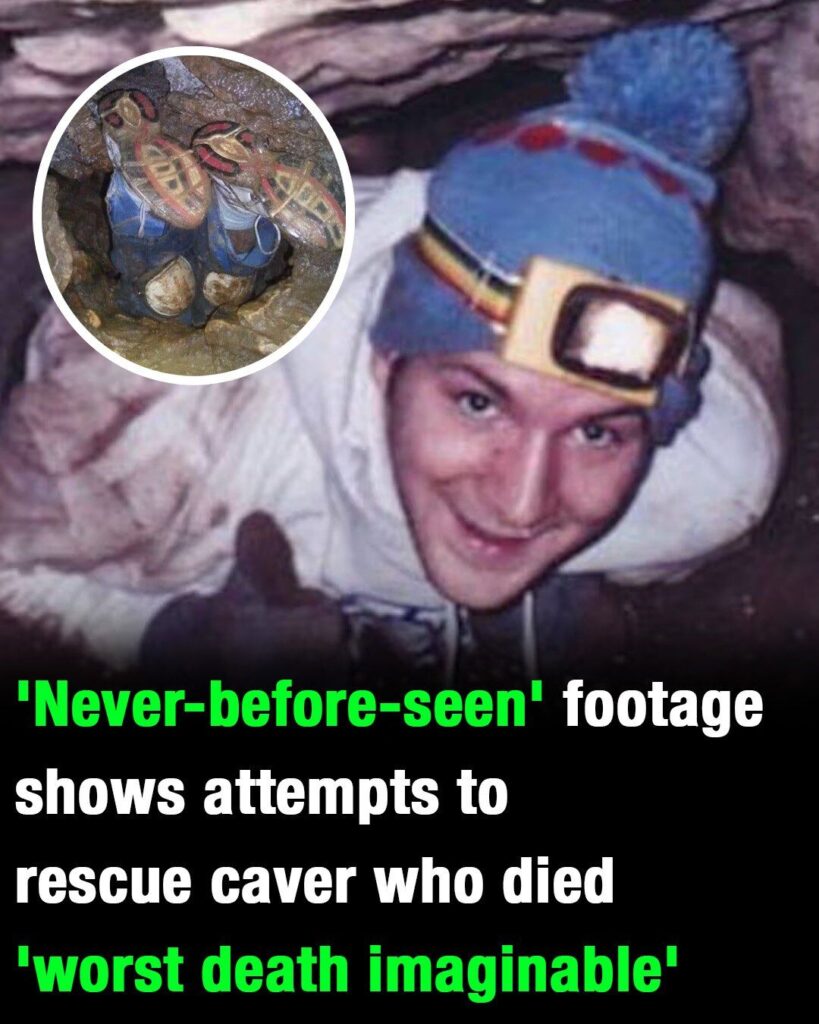
He thought it would become another memory to laugh about later — one more family adventure tucked beside stories of scraped knees, road trips, and harmless scares. Deep beneath the earth inside Utah’s infamous Nutty Putty Cave, John Edward Jones crawled forward through narrow limestone passages believing he still understood where he was going. The cave was familiar to many locals, famous for its twisting tunnels and tight squeezes that attracted thrill-seekers searching for adventure beneath the surface.
But somewhere in the darkness, one wrong turn changed everything forever.
Minutes later, John found himself trapped upside down inside a crack of rock so impossibly narrow rescuers would later struggle to believe a human body had entered it at all. His arms were pinned. His chest compressed. Blood rushed violently toward his head while gravity slowly transformed the cave itself into a death sentence.
And above him, no one yet understood how bad the situation truly was.
At first, confusion dominated the panic. John believed he had entered a known tunnel leading toward a larger chamber. Instead, he had crawled headfirst into an unmapped fissure that narrowed relentlessly the deeper he moved. When he finally realized the passage did not open ahead, he tried backing out.
He couldn’t.
Every movement wedged him tighter.
The cave gripped him like concrete.
Soon, the reality became horrifyingly clear: he was trapped completely upside down, deep underground, inside a space barely large enough to contain his body. The position alone was catastrophic. Humans are not built to remain inverted for long periods. Blood pressure spikes dangerously. Breathing becomes increasingly difficult. Organs strain against gravity in ways the body cannot sustain indefinitely.
And John was buried hundreds of feet inside solid rock.
By the time rescuers reached him, the nightmare had already begun transforming from rescue operation into survival race.
The scene confronting emergency crews was almost unimaginable. To even approach John required crawling through jagged limestone tunnels so tight many rescuers had to exhale fully just to squeeze forward inch by inch. The deeper they moved, the more dangerous conditions became. Darkness swallowed everything beyond flashlight beams. Sharp rock carved skin and equipment alike. The air felt thin, claustrophobic, suffocating.
Yet rescuers kept going.
For hour after exhausting hour, highly trained volunteers risked their own lives trying to save a man trapped where almost no one could even reach him safely. Some crawled through spaces barely wider than shoulders carrying ropes, pulleys, medical supplies, and hope balanced desperately against physics itself.
And somehow, through the darkness, they reached him.
John was conscious.
Talking.
Praying.
At times even apologizing to rescuers for the danger they faced trying to save him.
That detail haunted many people afterward. Even while trapped inside impossible conditions, he remained painfully aware others were risking their lives for him. Rescuers later described conversations filled with exhaustion, fear, faith, and fragile optimism flickering against overwhelming odds.
Above ground, his family waited helplessly while updates arrived slowly and inconsistently. Every passing hour deepened the danger. Doctors warned that prolonged inversion could eventually cause cardiac collapse, organ failure, or suffocation. Yet no one was willing to surrender hope while John remained alive beneath the earth.
So the rescue operation intensified.
Engineers and cave specialists designed elaborate pulley systems anchored directly into unstable limestone walls. Teams drilled bolts into rock while others mapped possible extraction angles through tunnels barely large enough to breathe inside. Every inch mattered. Every movement risked triggering collapse or wedging John even deeper.
Still, hope survived.
At one point, rescuers actually managed to begin pulling him upward. For several fragile moments, it seemed possible the impossible might happen — that John could somehow emerge alive from the stone prison swallowing him slowly.
Then disaster struck.
One of the anchor points failed catastrophically.
The pulley system snapped loose.
And John slipped deeper into the crack.
The sound echoed through the cave like a verdict.
Rescuers watched helplessly as gravity dragged him farther back into the narrow fissure, undoing precious hours of progress in seconds. Some later described the moment as emotionally devastating beyond words because everyone understood instantly what it likely meant.
The cave had won.
After that failure, conditions deteriorated rapidly. John grew weaker. Breathing became more labored. His heart strained under prolonged inversion while rescuers continued fighting against geology itself with fewer and fewer options remaining. Yet even then, many refused to give up emotionally.
People prayed underground beside him.
Strangers prayed above ground for him.
Across the country, news of the rescue spread as millions followed updates hoping for a miracle buried beneath Utah limestone.
But caves are unforgiving places.
They do not negotiate with courage or compassion.
Eventually, after more than a day trapped upside down inside darkness, John Edward Jones died inside Nutty Putty Cave at only 26 years old.
The grief afterward carried a strange heaviness because his death forced rescuers into an unbearable decision. Retrieving his body safely proved nearly impossible. The tunnel surrounding him remained dangerously unstable, and additional rescue attempts risked creating more fatalities.
In the end, officials made the heartbreaking choice to permanently seal the cave.
Nutty Putty Cave became his tomb.
Concrete sealed the entrance forever while John’s body remained deep inside the narrow passage where he took his final breath. The decision devastated many people, yet rescuers knew continuing operations could easily claim additional lives. One tragedy threatened becoming several.
Even today, the story continues haunting people not merely because of how John died, but because of how quickly ordinary adventure transformed into irreversible catastrophe. One wrong turn. One narrow passage mistaken for another. One moment of confidence inside a cave system indifferent to human survival.
The details linger painfully in public memory: the upside-down position, the darkness, the rescuers speaking calmly to him while time disappeared, the snapped pulley system extinguishing hope almost instantly.
Yet alongside the horror exists something else too:
Extraordinary human courage.
Rescuers willingly crawled into deadly conditions for someone they barely knew. Families waited with impossible hope long after logic turned cruel. Volunteers risked becoming trapped themselves because abandoning another human being underground felt unthinkable.
John’s story ultimately became more than a cave tragedy. It became a brutal reminder of how fragile life truly is — how thin the line separating adventure from disaster can become in a single moment.
Deep beneath the earth, inside silent stone untouched by sunlight, that lesson remains entombed forever alongside him.