
Republicans Push Back on Trump’s $350 Billion Pentagon Plan as Debt and Iran War Concerns Grow
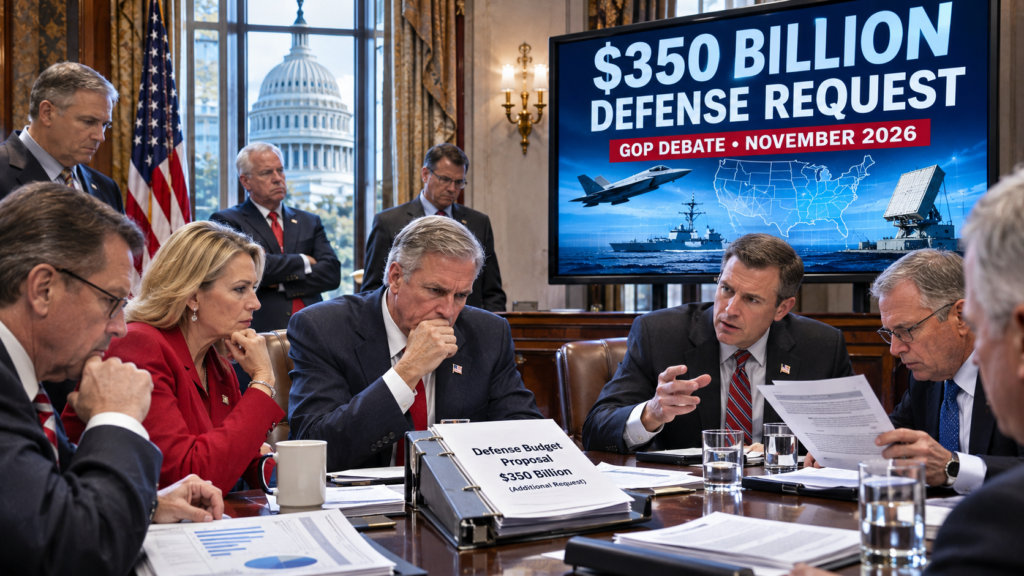
President Donald Trump’s push for an additional $350 billion in Pentagon funding is running into resistance from Republicans who are worried about adding to the national debt, the political fallout from the Iran war and whether the proposal can pass the House before Democrats take control of Congress in January.
Senate Republicans have put aside an immediate attempt to move the full package through a party-line budget bill and say they will first explore a bipartisan agreement with Democrats. Senate Majority Leader John Thune said Republicans want to see whether Democrats are willing to support military funding through the regular appropriations process. A partisan route remains possible, but the party has not secured agreement to pursue it.
Debt concerns split Republicans
The proposed $350 billion would be added to a $1.15 trillion base defense budget requested by the administration for fiscal year 2027, bringing the total request to about $1.5 trillion. The additional money is intended to support priorities including munitions, aircraft, ships, satellites and President Trump’s proposed missile-defense system.
Some Republicans say they support strengthening the military but are reluctant to approve another large spending package without identifying how it would be paid for. House Budget Committee Chairman Jodey Arrington warned that a clean $350 billion increase with no spending offsets would be difficult for many Republicans to accept, given the national debt and concerns about inflation and interest rates.
Senator Rand Paul has also criticized the idea of passing another partisan spending bill that would increase borrowing. Other conservative lawmakers have questioned whether the House would have enough votes to approve a package that adds substantially to the deficit.
Republicans consider a smaller defense package
Representative Mike Rogers, chairman of the House Armed Services Committee, said the full $350 billion request was not likely to pass in its current form. He suggested a smaller reconciliation package of around $100 billion could have a path forward, although significant obstacles remain.
Senate Republicans have also outlined a roughly $1.1 trillion defense appropriations proposal that shifts nearly $69 billion of the administration’s requested supplemental funding into the regular budget process. That approach would provide more predictable funding for some military priorities while avoiding the need to pass the entire $350 billion through a separate partisan bill.
Defense Secretary Pete Hegseth has argued that the additional money is necessary to replenish weapons and equipment used during military operations, including the conflict with Iran. The administration has pressed lawmakers to act before the end of the year, when Republicans will lose control of both chambers.
Iran war complicates negotiations
The funding debate is also tied to disagreements over the war with Iran. Democrats have opposed providing additional money that could support the military campaign without limits or conditions. Some Republicans are concerned that another partisan vote on defense spending could deepen the political backlash after the midterm elections, when voters expressed dissatisfaction with the conflict and rising energy costs.
The disagreement is complicating broader negotiations over government funding. Current federal funding is scheduled to expire on December 11, and lawmakers are trying to avoid a shutdown while they negotiate spending bills. Democrats have discussed a short-term extension that would move some major funding decisions into the next Congress.
Time is running out before the new Congress
Republicans have only a limited number of legislative days left before the new Congress convenes on January 3, 2027. That deadline has increased pressure on party leaders to decide whether to pursue a smaller defense package, negotiate with Democrats or leave some of the administration’s request for the next Congress.
For now, the full $350 billion proposal has not passed and is not guaranteed to receive a vote. The debate reveals a divide inside the Republican Party: many lawmakers want to increase military readiness, but they disagree over the size of the increase, how to pay for it and whether it should be tied to the administration’s Iran policy.
Sources: The Washington Post, November 19, 2026; Reuters, November 20, 2026; Axios, November 18, 2026; Federal News Network, November 19, 2026; CBS News, November 18, 2026. The $350 billion is an administration request, not approved funding. A smaller package remains under discussion.