
Trump, Xi and Putin Agree to Nuclear Risk Dialogue but Make No Arms Control Deal at Historic Summit
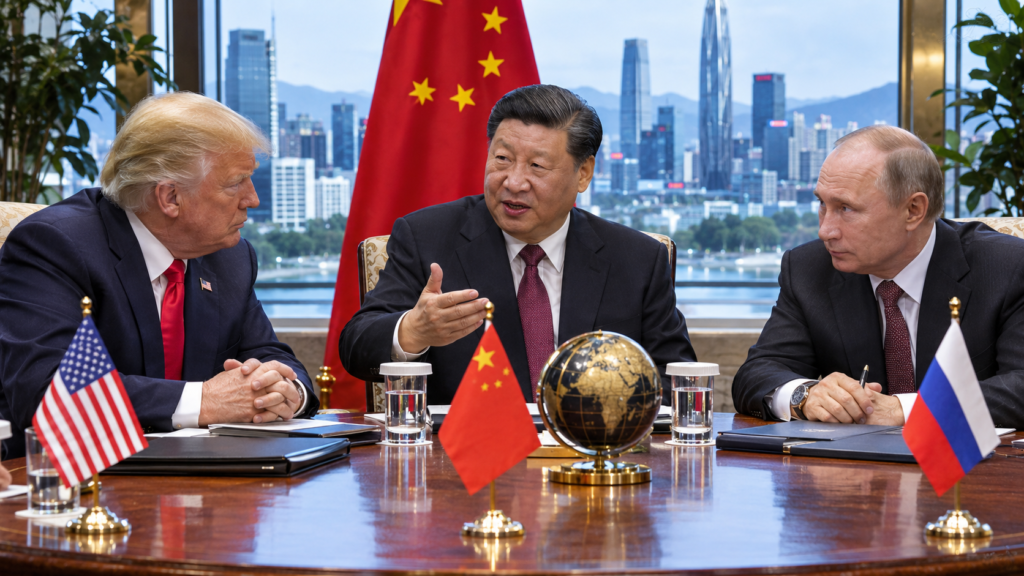
President Donald Trump, Chinese President Xi Jinping and Russian President Vladimir Putin have agreed to pursue dialogue on reducing nuclear risks, but their historic three-way meeting in Shenzhen produced no concrete arms control agreement, timetable or commitment to reduce nuclear weapons.
The November 19 summit brought the leaders of the three countries with the world’s largest nuclear arsenals together for their first trilateral meeting. The gathering took place during the Asia-Pacific Economic Cooperation summit and ended with a symbolic declaration that a nuclear war cannot be won and must never be fought.
The leaders also pledged to hold dialogue on reducing nuclear risks and preventing the spread of nuclear weapons. However, they did not announce formal negotiations, numerical limits on their arsenals or a schedule for future talks. Russian President Vladimir Putin described the declaration as nonbinding, while Trump acknowledged that reaching an agreement on nuclear limits would be difficult.
Trump says a nuclear agreement will be difficult
Speaking to Reuters by phone as he flew back to Washington, Trump said a mutual agreement to limit nuclear weapons would be hard to achieve but that he intended to keep working on the issue. He said he supported the concept but recognized the difficulty of asking countries with much larger arsenals to make substantial reductions.
Trump has said he wants a new, modernized arms control arrangement that includes China as well as Russia. The previous treaty limiting U.S. and Russian strategic nuclear forces, New START, expired in February 2026, leaving the two countries without that treaty’s binding limits and verification framework.
China remains reluctant to accept equal limits
One major obstacle is the difference in the size of the countries’ nuclear arsenals. The United States and Russia each possess thousands of nuclear warheads, while China’s arsenal is significantly smaller, although it has been expanding. Beijing has argued that it should not be required to accept the same numerical limits as Washington and Moscow while its stockpile remains far below theirs.
That gap makes a three-way treaty difficult. Washington wants China to take part in meaningful limits and greater transparency, while Beijing has resisted negotiations that could constrain its ability to build up its deterrent. Analysts say any agreement would need to address those different security concerns rather than simply impose identical caps on all three countries.
Ukraine and Iran were left without a breakthrough
The summit also raised expectations that the leaders might make progress on Russia’s war in Ukraine or the conflict involving Iran. But the joint declaration did not set out a peace plan for Ukraine, announce a ceasefire or provide a new framework for resolving the Iran conflict.
The Associated Press reported that the declaration omitted both wars. Trump said the issues had been discussed, but there was no public evidence that Xi or Putin had made commitments that would resolve either conflict. Ukrainian representatives were not part of the trilateral meeting, adding to concerns among U.S. allies that major powers could discuss security issues without the countries directly affected.
European leaders meeting in Berlin reiterated their support for Ukraine. Some expressed concern that the Shenzhen gathering gave Putin a high-profile opportunity to appear alongside the leaders of the United States and China without making significant concessions over the invasion.
A symbolic meeting with limited practical results
The summit was important for its symbolism: the leaders publicly acknowledged the shared danger of nuclear conflict and agreed that communication should continue. But arms control experts cautioned that a declaration is only a starting point. Without detailed negotiations, verification measures and specific commitments, it does not reduce the number of weapons or prevent a future arms race.
The next test will be whether the three governments establish a regular process for nuclear risk discussions and whether those talks can eventually address limits, transparency and crisis communication. For now, the Shenzhen summit has opened a diplomatic channel, but it has not produced the binding agreement Trump says he wants.
Sources: Reuters, November 19, 2026, reporting on Trump’s remarks after the summit; Associated Press, November 19–20, 2026, reporting on the trilateral declaration and its limited outcomes; Reuters, November 21, 2026, analysis of the summit’s diplomatic impact. The declaration is nonbinding and did not establish nuclear weapons limits or a timetable for negotiations.