
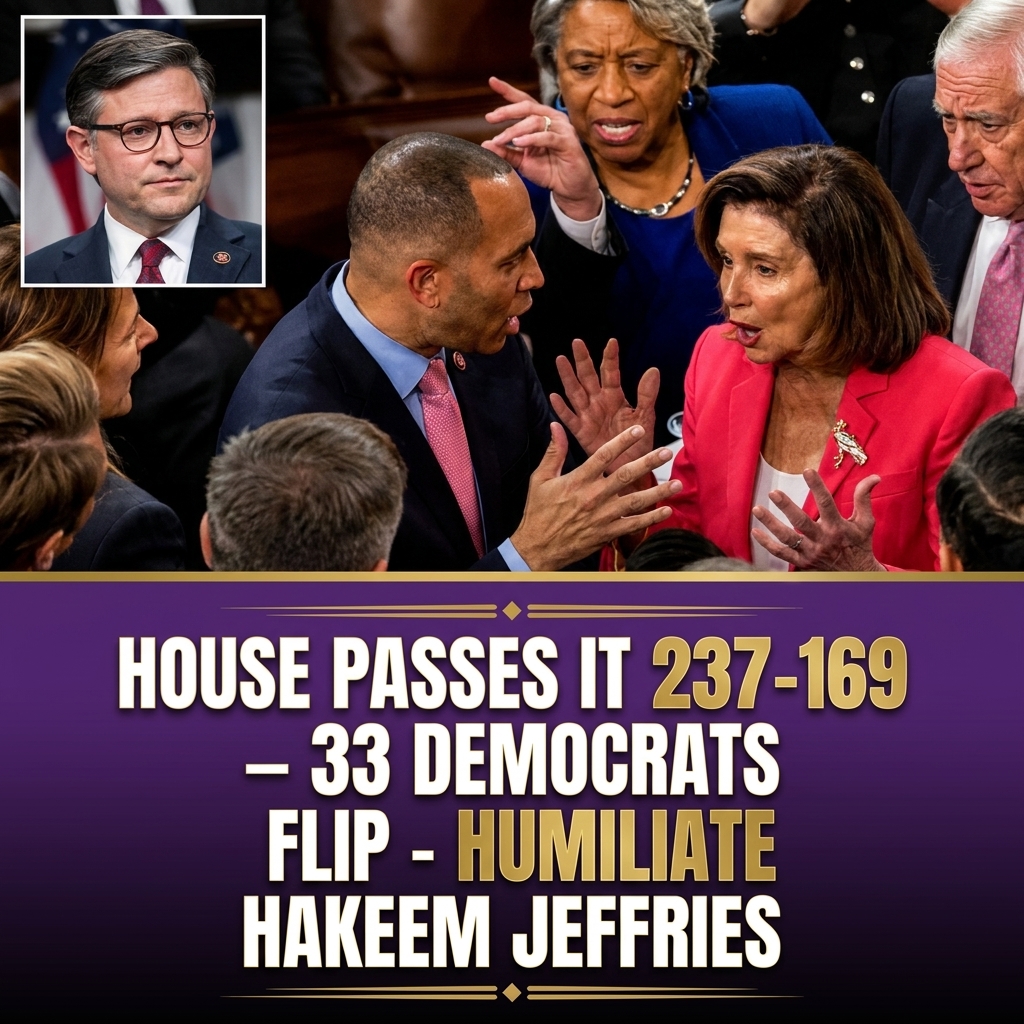
House Democrats split sharply over Israel again as 33 members joined Republicans to pass legislation that would restrict federal funding for colleges and universities participating in certain commercial boycotts of Israel.
The House approved H.R. 4795, the Protect Economic and Academic Freedom Act of 2026, in a 237-169 vote.
The measure received support from 203 Republicans, 33 Democrats and one independent. Two Republicans — Reps. Thomas Massie of Kentucky and Warren Davidson of Ohio — voted against it.
House Minority Leader Hakeem Jeffries opposed the legislation, as did former Speaker Nancy Pelosi and longtime Democratic Rep. James Clyburn.
The bill was introduced by Republican Rep. Virginia Foxx of North Carolina with Democratic Rep. Josh Gottheimer of New Jersey as a co-sponsor.
It would amend the Higher Education Act to make colleges participating in federal student-aid programs ineligible if they engage in what the legislation calls a “nonexpressive commercial boycott” of Israel.
The bill defines such a boycott as commercial action intended to limit business relationships with Israel or entities organized, licensed or regulated under Israeli law when the action is not based on a valid business reason.
Universities receiving certain Title VI funds would also have to certify annually that students and faculty are not unreasonably blocked from participating in academic programs in Israel and that Israeli students and faculty receive comparable access to programs at U.S. institutions.
Supporters argue the legislation targets institutional commercial discrimination rather than individual political speech.
Foxx said the measure was intended to counter the Boycott, Divestment and Sanctions movement on college campuses, while Gottheimer argued that academic boycotts can isolate Jewish and Israeli students and faculty.
Gottheimer argued the Boycott, Divestment and Sanctions movement seeks Israel’s destruction and should have no place on American campuses.
“The goal of the BDS movement is the destruction of the democratic State of Israel,” Gottheimer said.
He called Israel “America’s critical ally in the global fight against terror” while defending the legislation against progressive criticism.
Opponents argue the bill could threaten First Amendment rights and academic freedom by attaching federal funding consequences to institutional decisions involving Israel.
Jeffries said he opposes BDS but argued H.R. 4795 was poorly written and could give the executive branch excessive authority over colleges and universities.
Rep. Jerry Nadler, D-N.Y., also opposed the measure despite his criticism of BDS, arguing that boycott activity can constitute constitutionally protected political expression.
J Street similarly opposed the legislation, warning that it could penalize universities over decisions involving both Israel and Israeli settlements in the West Bank.
The vote comes less than two months after House Democrats divided even more dramatically over direct military assistance to Israel.
In July, the House rejected a Massie amendment that would have eliminated $3.3 billion in security assistance to Israel.
Advertisement
That proposal failed 314-104, but 103 Democrats joined Massie in supporting the cut, while 98 Democrats opposed it and 10 voted present. Jeffries opposed eliminating the aid, while Democratic Whip Katherine Clark supported Massie’s amendment.
The two votes highlight a continuing disagreement within the Democratic caucus over U.S. policy toward Israel following the Gaza war and the Oct. 7, 2023, Hamas attack.
Some Democrats continue to emphasize the U.S.-Israel security relationship and efforts to combat antisemitism, while others have increasingly criticized Israeli government policies and U.S. financial support.
H.R. 4795 now moves to the Senate, where it would need enough support to overcome the chamber’s procedural hurdles before it could reach President Donald Trump’s desk.
For now, the House vote provides another example of the increasingly complicated coalition surrounding Israel policy in Congress: most Republicans supported the bill, most Democrats opposed it, but a sizable group of Democrats crossed party lines to approve it.