
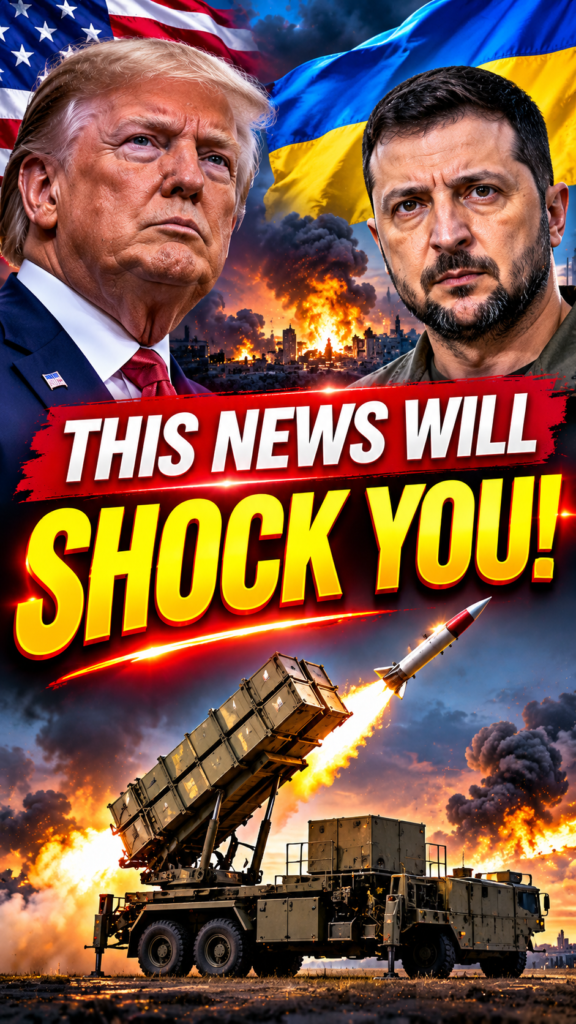
Trump’s Ukraine Dilemma: U.S. Approves 500 Patriot Missiles as Russia Intensifies Winter Attacks
WASHINGTON/KYIV — October 31, 2026 — A major new U.S. decision is putting the Ukraine war back at the center of Washington’s foreign-policy debate.
The United States has approved the sale of 500 Patriot PAC-3 missile interceptors to Ukraine in a deal estimated at $2.1 billion, giving Kyiv a potentially important boost as Russia continues its attacks on Ukrainian cities, energy facilities and critical infrastructure.
But there is a major problem: the missiles approved in the deal are not expected to arrive quickly.
Ukrainian President Volodymyr Zelenskyy welcomed the American decision but warned that production and delivery could take years. That has created an uncomfortable question for Kyiv and Washington: How can Ukraine strengthen its air defenses for the coming winter if some of the most urgently needed interceptors are still years away?
🇺🇸 A Major U.S. Decision — But Not an Immediate Solution
The Patriot system is among Ukraine’s most important tools for defending against Russian missile attacks, particularly ballistic missiles that are difficult for many other air-defense systems to intercept.
The newly approved package covers 500 PAC-3 interceptors. The purchase is expected to be financed with support from European partners, including Canada, Germany and Norway.
For Washington, the decision represents one of the most significant steps to provide Ukraine with defensive weapons during President Donald Trump’s second administration.
But the timing matters.
Ukraine is already facing an intensified Russian air campaign as winter approaches. Ukrainian officials have repeatedly warned that Russia is targeting energy infrastructure in an effort to put pressure on the country during the coldest months.
That makes the delivery schedule almost as important as the size of the weapons package.
Zelenskyy has urged the United States to find a way to provide missiles from existing stocks while newly manufactured interceptors are produced. The goal is to prevent a dangerous gap between Ukraine’s current needs and future deliveries.
🚨 Russia’s Attacks Are Putting Pressure on Ukraine’s Energy System
The timing of the American announcement comes as Russian attacks are intensifying.
Over the past day, Russian attacks killed at least five people and injured dozens more, according to Ukrainian regional authorities. Ukrainian officials also reported that Russia launched 134 drones overnight, while Ukrainian air defenses intercepted 105 of them.
The attacks damaged energy infrastructure in several areas.
President Zelenskyy said around 200,000 households in Dnipropetrovsk Oblast and more than 80,000 households in Kyiv Oblast were without electricity after Russian strikes.
Other infrastructure, including heating, gas and railway facilities, was also targeted.
For ordinary Ukrainians, the issue is therefore much bigger than military hardware.
It is about whether homes will have electricity.
Whether heating systems will continue operating.
Whether hospitals and businesses can function.
And whether Ukraine can survive another winter under sustained Russian missile and drone attacks.
🇺🇸 Trump Faces a Difficult Ukraine Decision
The Patriot decision also comes at a complicated moment in U.S.–Ukraine relations.
President Trump has repeatedly pushed for an end to the war and has criticized Kyiv over its approach to negotiations. At the same time, his administration is approving major defensive weapons for Ukraine.
That creates a difficult balancing act for Washington.
The Trump administration wants diplomacy to succeed, but Ukraine still needs weapons to defend itself while negotiations remain unresolved.
U.S. Secretary of State Marco Rubio acknowledged the uncertainty on October 31, saying he did not know whether a negotiated peace was ultimately achievable.
He also said Washington was not claiming that a settlement was imminent.
That statement is significant.
It suggests that despite diplomatic contacts between Washington, Moscow and Kyiv, the United States does not believe a final peace agreement is around the corner.
🕊️ Washington Is Also Exploring a Limited Black Sea Ceasefire
At the G20 foreign ministers’ meeting in Atlanta, Rubio said there was growing international interest in a limited ceasefire in the Black Sea.
The idea would focus on protecting shipping and allowing grain and energy shipments to move safely.
Rubio said the United States was reviewing proposals from countries including Turkey and India.
Such an agreement would not end the Russia-Ukraine war, but Washington sees a limited arrangement as a possible way to reduce one dangerous consequence of the conflict: disruption to food and energy supplies.
The United States is continuing to press for a broader negotiated settlement, but Rubio acknowledged that such a deal is not immediately within reach.
🇷🇺 Ukraine Is Also Striking Deep Inside Russia
While Russia continues attacking Ukraine, Kyiv is increasingly using long-range strikes against Russian military and energy-related infrastructure.
On October 31, Ukrainian forces reportedly struck facilities in Russia’s Rostov region and conducted drone attacks affecting oil-refining infrastructure in Ufa.
The Institute for the Study of War assessed that Ukrainian strikes were also putting pressure on Russian logistics, including railway infrastructure in occupied Ukrainian territory.
These attacks demonstrate how the war has increasingly become a contest involving drones, long-range missiles, energy infrastructure and supply chains far beyond the immediate frontline.
⚠️ The Winter Could Become a Major Test
The coming months could be decisive.
Ukraine needs enough air-defense ammunition to protect its cities and energy network.
Russia appears determined to continue applying pressure through missile and drone attacks.
And Washington is simultaneously trying to maintain military support while pushing both sides toward negotiations.
That puts the United States in an increasingly complicated position.
If Ukraine receives additional air-defense missiles quickly, Kyiv could have a better chance of protecting critical infrastructure through the winter.
If deliveries take years, Ukraine may have to rely heavily on its existing stocks, European assistance and additional purchases from international partners.
🇺🇸 Why Americans Should Pay Attention
For Americans, the story is not simply about another weapons package overseas.
The Ukraine war increasingly affects U.S. national security, NATO, global energy markets, European stability and Washington’s relationship with Moscow.
The United States is also spending political and diplomatic capital trying to bring the war toward an end.
At the same time, Russia’s attacks and Ukraine’s long-range strikes are creating risks that could extend beyond the battlefield.
The question facing Washington is therefore becoming more complicated:
How much military support should America provide while simultaneously trying to negotiate peace?
That is the dilemma President Trump and his administration now face.
🔥 What Happens Next?
Several developments will be worth watching closely in the coming weeks.
First, whether the United States can find a way to get Patriot interceptors to Ukraine sooner than the normal production timeline.
Second, whether Russia and Ukraine agree to any limited Black Sea arrangement.
Third, whether diplomatic contacts between Washington, Moscow and Kyiv produce a serious path toward negotiations.
And finally, whether Russia increases its attacks on Ukrainian energy infrastructure as winter approaches.
For Ukraine, the stakes are immediate.
For Russia, the war remains a test of its ability to sustain military operations and absorb long-range attacks.
For the United States, it is a test of whether military pressure and diplomacy can be combined into a strategy capable of moving the conflict toward an eventual settlement.
The approval of 500 Patriot missiles is therefore more than a weapons sale.
It is another signal that Washington is still deeply involved in the Ukraine conflict — even as the Trump administration continues searching for a diplomatic exit.
The biggest question now is not simply whether Ukraine will receive more weapons. It is whether those weapons can arrive in time to matter.