
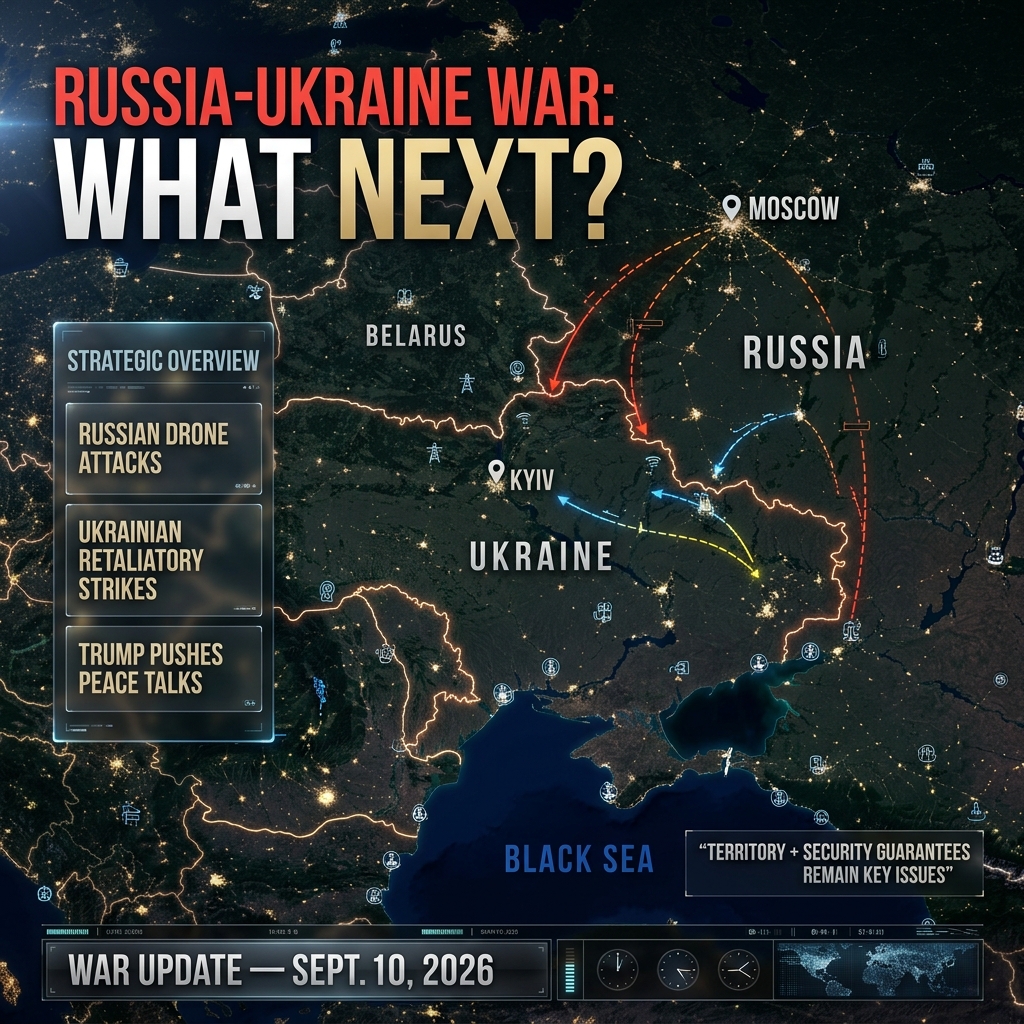
The Russia-Ukraine war is entering another uncertain phase.
On one side, the Trump administration is pushing diplomatic efforts aimed at ending the conflict.
On the other, Russian and Ukrainian forces continue launching attacks against each other’s infrastructure.
The contradiction has become one of the defining features of the current situation.
Diplomats talk about peace while missiles and drones continue flying.
New Russian Attacks
Russian drone attacks were reported across multiple Ukrainian regions.
Reuters reported deaths and injuries in Kyiv, Sumy and near the Ukraine-Moldova border.
The latest attacks targeted a mixture of urban and logistical areas.
For Ukraine, protecting transportation and civilian infrastructure has become increasingly important.
Russia has repeatedly used long-range drones to attack targets far from the front lines.
Ukraine Responds
Ukraine has also continued its long-range strike campaign against Russian infrastructure.
President Zelenskyy has highlighted Ukrainian attacks against Russian military and energy-related targets.
The strategy is designed to place pressure on Russia far beyond the immediate battlefield.
Ukrainian drones have increasingly demonstrated the ability to reach targets deep inside Russian territory.
Why Long-Range Drones Matter
Modern drones have changed the nature of the conflict.
They are relatively inexpensive compared with traditional missiles and can be produced in large numbers.
Ukraine has invested heavily in domestic drone production.
Russia has done the same.
The result is a conflict in which both sides can attack targets hundreds or even thousands of kilometers away.
That makes geographic distance less meaningful than it once was.
Sochi Attack
One of the latest examples came in Russia’s Black Sea resort city of Sochi.
Russian regional authorities said sea-drone attacks injured eight people and damaged beach infrastructure.
Reuters reported that verified video showed an explosion near the Sochi waterfront.
The incident is notable because Sochi is far from the main front line and is associated with tourism and Russian political leadership.
The city also hosts a presidential residence.
Why Ukraine Is Targeting Russia
Ukraine says long-range strikes are necessary to reduce Russia’s ability to wage war.
Targets can include military facilities, fuel infrastructure, ports and industrial sites.
The objective is to increase the cost of Russia’s military campaign.
Moscow argues that Ukrainian strikes against Russian territory represent escalation.
The cycle therefore continues.
Russia attacks Ukrainian cities.
Ukraine attacks Russian infrastructure.
Each side says its actions are defensive or necessary.
Diplomacy Continues Anyway
Despite the fighting, diplomacy has not completely stopped.
Trump has said Putin wants a deal.
American officials continue to communicate with both Moscow and Kyiv.
The administration has discussed possible future negotiations involving Trump, Putin and Zelenskyy.
But the conditions for a deal remain extremely difficult.
Territory Is Still the Biggest Problem
One of the most difficult issues is territory.
Russia wants recognition of territorial changes.
Ukraine has repeatedly rejected surrendering territory as the price of peace.
That disagreement cannot easily be solved through diplomatic language.
A peace agreement would have to determine what happens to occupied Ukrainian territories.
It would also need to establish security arrangements designed to prevent another invasion.
Ukraine Wants Security Guarantees
Ukraine is unlikely to accept a settlement that leaves it vulnerable to another Russian attack.
That is why Kyiv has repeatedly demanded security guarantees from Western countries.
The question is what those guarantees would actually mean.
Would NATO countries promise military intervention?
Would they provide weapons automatically?
Would European countries deploy troops?
Each option carries enormous political and military consequences.
Russia Wants Security Guarantees Too
Moscow also argues that its security concerns must be addressed.
Russia has opposed NATO expansion and Ukraine’s deeper military relationship with Western countries.
The United States and European governments reject the idea that Russia should have the right to determine Ukraine’s foreign policy.
This disagreement goes beyond territory.
It concerns the future security structure of Europe.
Trump Faces a Difficult Test
For Trump, ending the war would be a major foreign-policy achievement.
But a deal that Ukraine considers unfair could generate strong opposition.
A deal that Russia refuses to implement could collapse.
And a temporary ceasefire without a political settlement could simply delay another round of fighting.
That means the administration needs more than an agreement to stop shooting.
It needs a settlement both sides believe they can live with.
What Could Happen Next?
There are several possibilities.
The first is renewed negotiations.
The second is a temporary ceasefire focused on humanitarian issues.
The third is continued fighting with occasional diplomatic meetings.
The fourth is a major escalation if either side decides that military pressure offers a better path than negotiation.
At the moment, none of these outcomes can be ruled out.
The Human Cost
Behind every military map are civilians.
Homes can be destroyed.
Businesses can close.
Families can be separated.
Power infrastructure can be damaged.
Millions of Ukrainians have already experienced some form of displacement or disruption.
The longer the war continues, the greater the cost becomes.
The Bottom Line
The latest attacks demonstrate a simple reality:
The war is still active even while diplomacy continues.
Trump says Putin wants a deal.
Ukraine says Russia must face stronger pressure.
Russia continues demanding major concessions.
Neither side has yet accepted the conditions necessary for a comprehensive settlement.
That means the coming weeks could be crucial.
If diplomacy produces a breakthrough, the conflict could begin moving toward a different phase.
If negotiations fail, both sides are likely to continue expanding their long-range strike capabilities.
For now, the battlefield remains active and the diplomatic door remains open—but neither side has yet walked through it.