
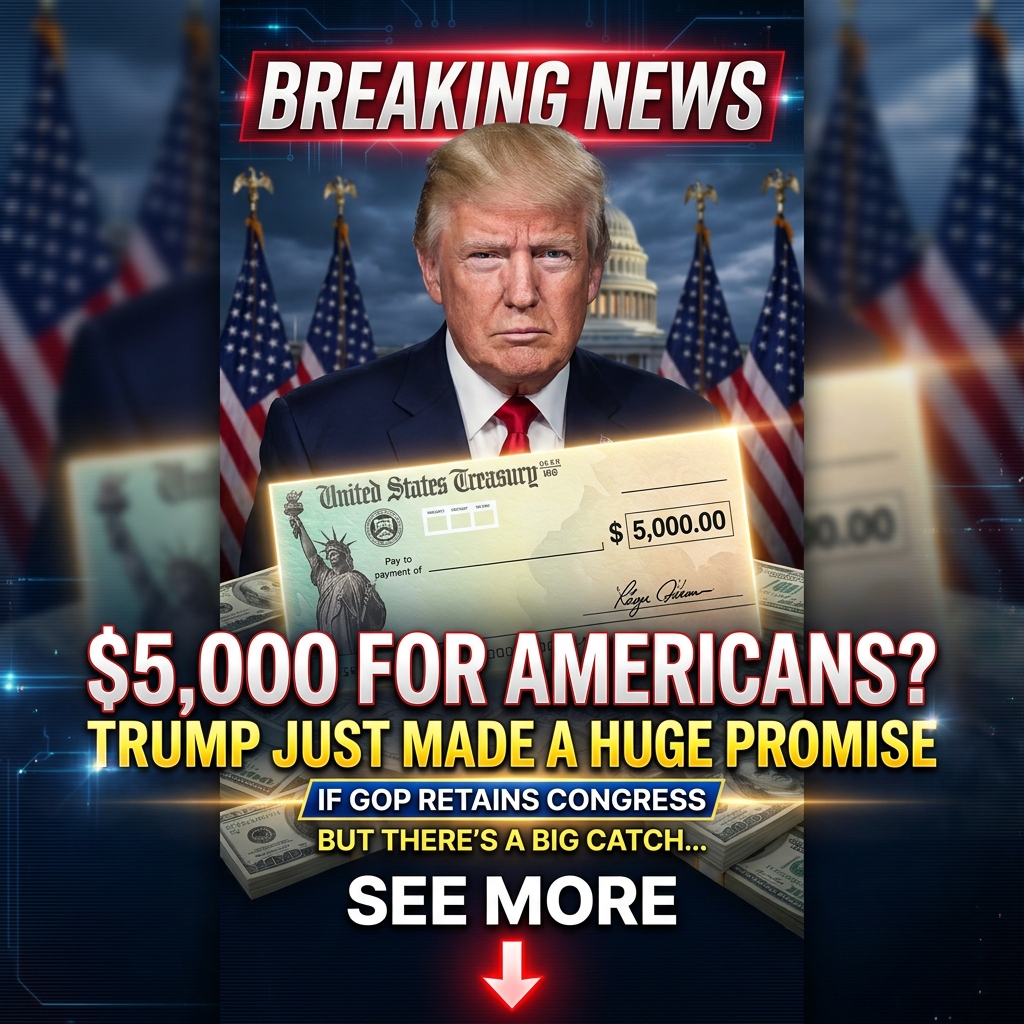
“If the Republicans win, you win with us — and you get $5,000.”
Those words from President Donald Trump immediately grabbed attention Wednesday night.
Speaking at the Republican Party’s unusual 2026 midterm convention in Dallas, Trump announced what he called a “Trump Dividend” — a proposed $5,000 payment to adult U.S. citizens if Republicans maintain control of both chambers of Congress in November.
For millions of Americans, the number alone was enough to make the announcement go viral.
$5,000.
A direct payment.
Money that, according to Trump’s proposal, would have to be spent inside the United States.
But almost immediately after the announcement, another question began spreading:
How would it actually work?
And that question is much more complicated than the headline makes it sound.
The announcement that caught America off guard
Trump’s announcement came during a Republican convention that was already attracting enormous attention because the president has placed himself at the center of the 2026 midterm campaign.
Rather than treating the election as an ordinary congressional contest, Trump has encouraged voters to view the election as a decision about his administration and its agenda.
Then came the $5,000 proposal.
Trump compared the idea to a successful company distributing money to its shareholders.
His message was simple:
If Republicans win control of both the House and Senate, American adults could receive a $5,000 dividend.
But Trump did not provide a complete explanation of how the program would be created or funded.
And that is where the story gets much more interesting.
💰 How much money would this actually require?
A $5,000 payment sounds manageable when you think about one household.
But multiply $5,000 by hundreds of millions of adults and the number becomes enormous.
Independent estimates put the potential cost at more than $1 trillion if the payment were broadly distributed.
One analysis estimated that giving $5,000 to every adult could cost approximately $1.35 trillion. A narrower program excluding wealthier households could still cost more than $1 trillion.
That immediately raises another question:
Where would all that money come from?
Trump has connected the proposal to the strength of the U.S. economy and his administration’s tariff policies.
But tariff revenue alone would not automatically create a $5,000 fund for every American adult.
The government would need an actual mechanism to authorize and distribute the payments.
And that brings Congress into the picture.
🏛️ Trump cannot simply send the money tomorrow
This is perhaps the most important part of the story.
Trump’s announcement is a proposal and campaign promise, not a check that Americans are currently entitled to receive.
A program involving hundreds of billions or more in federal payments would require congressional action and a legally authorized funding mechanism.
The president does not simply have unlimited authority to create a massive new federal spending program by announcing it from a convention stage.
That means Republicans in Congress would have to decide whether they support the idea.
And that could become a major political fight.
Some Republicans could support the plan because direct payments are popular with voters.
Other lawmakers may argue that the money should instead be used to reduce the national debt or finance other government priorities.
The United States is already carrying more than $40 trillion in national debt, making the cost of a proposal this large an especially sensitive issue.
👀 But there’s another detail Americans need to watch
Trump initially described the proposal as a payment to every adult citizen.
But Vice President JD Vance later suggested that wealthy Americans could potentially be excluded.
That means the final eligibility rules, if the proposal ever becomes legislation, could look very different from the simple headline:
“$5,000 for every American.”
There could eventually be income limits.
There could be citizenship requirements.
There could be tax implications.
There could even be restrictions on how the money is distributed.
None of those details have been finalized.
And that’s why Americans should be careful with social-media posts claiming that everyone has already been approved for a $5,000 payment.
That is not what has happened.
🇺🇸 Why would the money have to be spent in America?
Trump added another unusual condition when he announced the proposal.
He said the dividend would have to be spent inside the United States.
That appears designed to keep the money circulating through the American economy.
If households received billions of dollars and spent that money at U.S. stores, restaurants, businesses and service providers, the spending could theoretically create additional economic activity.
But there is another side to the argument.
A sudden injection of a huge amount of money into the economy could also increase demand.
If production does not increase enough to meet that demand, prices can rise.
That makes inflation another issue policymakers would have to consider.
America has already spent years dealing with the consequences of elevated consumer prices.
So the question isn’t simply:
“Would Americans like $5,000?”
Of course many households would.
The bigger economic question is:
“What happens after everyone receives it?”
🗳️ Why announce it before the midterms?
The timing is impossible to ignore.
The 2026 midterm elections are approaching, and control of Congress is at stake.
Historically, the president’s party often faces significant losses during midterm elections.
Trump clearly wants to change that pattern.
Republicans have organized an unusual national midterm convention in Dallas, putting Trump at the center of their campaign strategy.
The $5,000 proposal fits perfectly into that strategy because it gives voters a simple financial message.
Instead of talking only about complicated tariff policies, government revenue or economic statistics, Republicans can point to one easy-to-understand idea:
“You could receive $5,000.”
Democrats, meanwhile, are likely to focus on the cost, the national debt and whether the proposal is realistic.
That could make the $5,000 plan one of the biggest economic arguments of the midterm campaign.
⚠️ There is still a major “if”
There is an important word in Trump’s announcement:
IF.
The proposal depends on Republicans retaining control of both the House of Representatives and the Senate.
That means the proposal is directly connected to the election.
Trump said that if Republicans win both chambers, the dividend could be issued.
But even a Republican victory would not automatically mean Americans receive $5,000.
Congress would still have to act.
Funding would still have to be established.
Eligibility would still have to be determined.
And the administration would have to work out how the payments would actually be distributed.
So there are several steps between a campaign announcement and an actual payment.
💵 What about Trump’s previous payment proposal?
This isn’t the first time Trump has discussed giving Americans money connected to tariff revenue.
Previously, he floated the idea of $2,000 tariff-funded payments for Americans.
That proposal never became a nationwide payment program.
The new $5,000 idea is considerably larger.
And because of that, it is likely to face even more scrutiny.
Supporters may argue that Americans should directly benefit from money collected through Trump’s trade policies.
Critics will argue that the government should use the revenue to reduce debt or avoid additional spending.
That debate is likely to become much louder as the election approaches.
🔥 So… will Americans actually get $5,000?
Right now, there is no $5,000 check being sent out.
There is no finalized nationwide payment program.
There is no official payment date.
There is no finalized eligibility list.
There is no guarantee that Congress will approve the proposal.
What exists today is Trump’s public proposal to create a $5,000 dividend if Republicans retain control of Congress.
That distinction is extremely important.
Social media is already full of posts that can make the announcement sound like the payments have already been approved.
They have not.
The proposal still faces political, legal and financial hurdles.
🇺🇸 Why this could become one of the biggest stories of the 2026 election
Regardless of whether the proposal becomes law, Trump has accomplished one thing immediately:
He has put $5,000 into the national political conversation.
That number is easy to remember.
It is easy to share.
And it gives voters something very concrete to discuss.
Republicans can use it to argue that Trump’s economic policies could directly benefit American households.
Democrats can use it to argue that the plan is financially unrealistic and potentially irresponsible.
And voters will ultimately have to decide which argument they believe.
The proposal also demonstrates how different the 2026 midterms could be.
Trump isn’t simply asking voters to choose between individual congressional candidates.
He is asking them to judge his presidency.
And now he has added a potentially life-changing number to that argument:
$5,000.
But before anyone starts planning what they would buy with that money, there is one thing to remember:
This is a proposal — not a guaranteed payment.
The election comes first.
Then Congress would have to act.
And only after that would Americans know whether the “Trump Dividend” ever becomes reality.
For now, the $5,000 promise has become one of the most talked-about political announcements of the 2026 midterm campaign.
And this story is far from over.