
Senate Rejects Iran War Powers Resolution in 48-51 Vote, Backing Trump’s Military Campaign
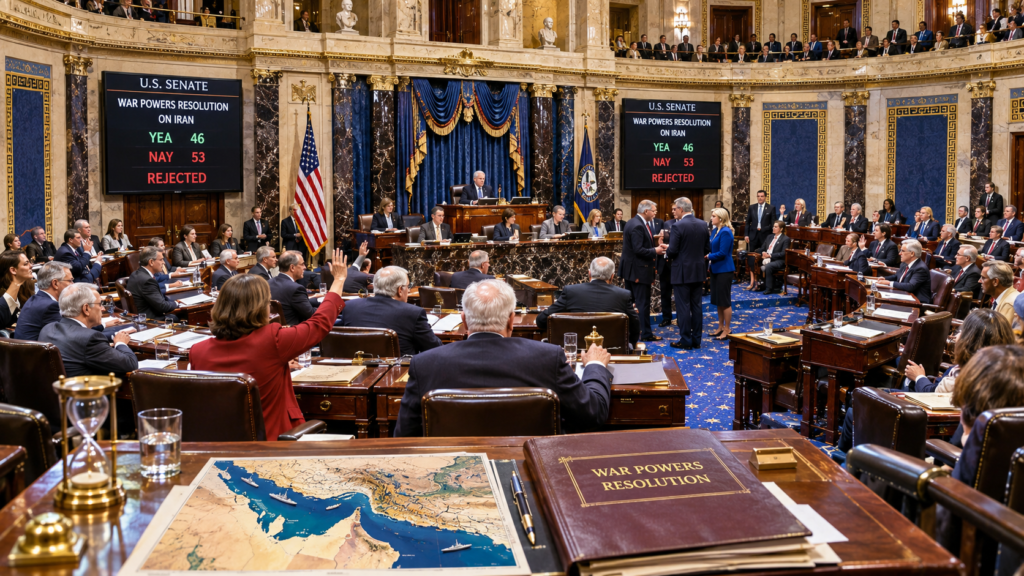
The U.S. Senate has rejected a resolution that would have directed President Donald Trump to withdraw American forces from unauthorized military operations against Iran, giving the White House another political victory as the conflict continues to divide Congress and the country.
The Senate voted 48-51 on November 19 against the measure, which had previously passed the House of Representatives. The vote was the first major congressional test of the Iran war since Republicans suffered heavy losses in the November 3 midterm elections, where frustration over the conflict and its economic impact became central campaign issues.
Three Republicans joined Democrats
Republican Senators Susan Collins of Maine, Lisa Murkowski of Alaska and Rand Paul of Kentucky voted with Democrats to support the resolution. Democratic Senator John Fetterman of Pennsylvania was the only member of his party to oppose it. The final vote left the measure short of the support needed to advance.
The resolution would have required Trump to end U.S. participation in hostilities against Iran unless Congress authorized the military action. Supporters argued that the administration had not provided a sufficiently clear legal basis or strategy for continuing the war and that Congress must reclaim its constitutional role in decisions about military force.
Republicans who opposed the measure said the president should retain flexibility while U.S. forces face threats and negotiations remain uncertain. Senator Tim Sheehy of Montana argued that the United States should be allowed to continue operations until the threat from Iran is addressed.
Democrats say voters want the war to end
Democrats brought the resolution forward after campaigning on concerns about the cost and duration of the conflict. Senator Peter Welch of Vermont said voters had made their opposition clear, while Senator Tammy Baldwin of Wisconsin warned that continued fighting puts American service members at risk.
According to reporting by Reuters, a Reuters/Ipsos poll found that only 31% of Americans approved of the war. Pentagon figures cited in the report showed the conflict had cost more than $47 billion by late October. The financial burden has become an important part of the debate, alongside casualties and the risk of a wider regional confrontation.
House had already passed the measure
The House approved the resolution in September by a 220-204 vote. The Senate rejection means the measure will not proceed through Congress in its current form. The vote does not, by itself, provide a new authorization for the war; it leaves the administration’s current military policy in place while the broader legal and political dispute continues.
Under the War Powers Resolution of 1973, Congress has mechanisms to direct the removal of U.S. forces from hostilities, although administrations of both parties have challenged aspects of how the law can be used. The White House has previously argued that similar measures do not legally constrain the president in the way their supporters claim.
Another confrontation is likely in 2027
Democrats have said they intend to keep pressing the issue when they take control of both chambers in January. They could pursue additional war powers votes and attempt to use defense appropriations or other funding legislation to restrict the administration’s military campaign.
Republicans, meanwhile, remain divided between those who support Trump’s approach and a smaller group calling for clearer limits or a stronger congressional role. The November 19 vote showed that the president still has enough Republican support in the Senate to defeat the latest effort to curb his authority over the Iran conflict.
The outcome does not settle the future of the war. It does, however, highlight the political challenge facing lawmakers as the conflict continues, costs rise and the next Congress prepares for a renewed fight over who has the authority to decide when American military involvement should end.
Sources: Reuters, November 19, 2026; CBS News, November 19, 2026; Stars and Stripes, November 19, 2026; Roll Call, November 19, 2026. The Senate vote was 48 in favor and 51 opposed; three Republicans supported the resolution and one Democrat opposed it.