
Trump Returns From Asia Praising Xi and Putin Meetings as Questions Remain Over Ukraine and Trade
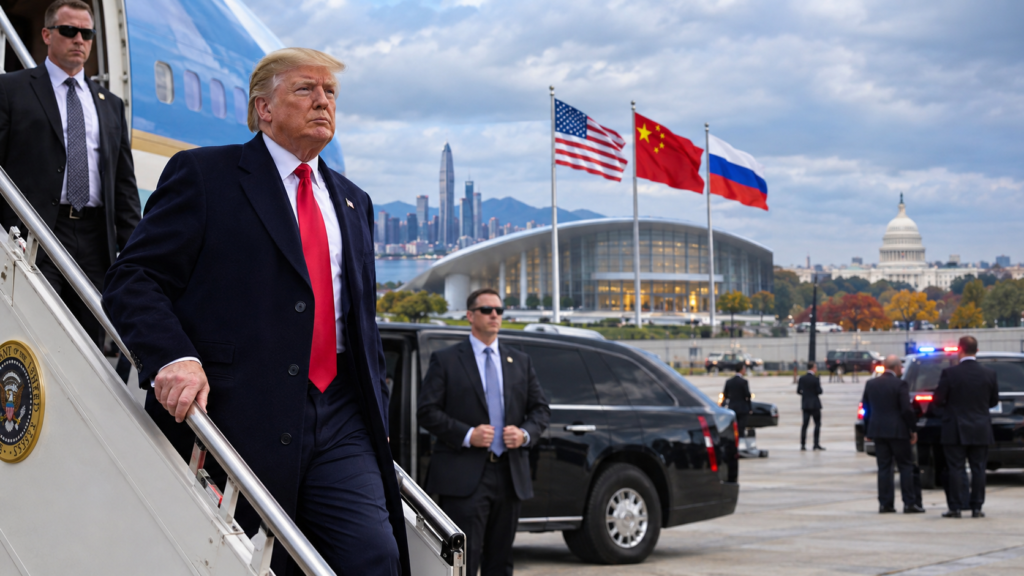
President Donald Trump returned to Washington after a high-profile Asia trip that included meetings with Chinese President Xi Jinping and Russian President Vladimir Putin, presenting the journey as a diplomatic success while leaving major questions about trade, nuclear weapons and Russia’s war in Ukraine unresolved.
The most closely watched event took place November 19 in Shenzhen, China, where Trump met separately with Xi and Putin before joining them for an unprecedented trilateral discussion. The meeting brought together the leaders of the world’s three largest nuclear powers during the Asia-Pacific Economic Cooperation summit.
Trump described the trip as “great” and “highly consequential” in a social media post as he departed China. He later told reporters that his relationships with Xi and Putin were strong and rated the trilateral meeting highly. The White House said the trip also included discussions with regional leaders and trade arrangements involving Thailand and the Philippines.
Nuclear risks discussed, but no major arms-control agreement
The three leaders issued a joint declaration opposing nuclear war and supporting continued dialogue on reducing nuclear risks. However, the statement did not announce binding cuts to nuclear arsenals, a timetable for negotiations or a new arms-control treaty.
The lack of a concrete agreement leaves a difficult diplomatic challenge in place. The United States and Russia possess far larger nuclear stockpiles than China, while Beijing has resisted joining numerical arms-control talks on the same terms as Washington and Moscow. The expiration of the New START treaty earlier this year has added urgency to efforts to establish new limits.
Ukraine remains a major unanswered question
Russia’s war in Ukraine was one of the biggest issues hanging over the trip, but it did not feature prominently in the public outcome of the trilateral meeting. Ukrainian President Volodymyr Zelenskyy was not present in Shenzhen, and the leaders did not announce a new peace framework or a ceasefire agreement.
Trump said the United States would not make decisions about the war without Ukraine being represented. At the same time, his public praise for Putin and his suggestion that the Russian president wanted a diplomatic solution drew criticism from Democrats, who argued that warm personal relations should not substitute for pressure on Moscow to end its invasion.
Senate Democratic leader Chuck Schumer criticized the meeting, calling it a diplomatic embarrassment and arguing that Trump had offered the Russian and Chinese leaders too much praise without securing meaningful concessions.
Trade and economic claims face scrutiny
Trade was another central theme of the trip. Trump highlighted agreements and investment announcements involving Asian partners, but the details and economic value of some claims remain subject to scrutiny. In a fact check published after his return, The Associated Press examined several statements Trump made at his November 20 news conference, including claims about new investment, gasoline prices, manufacturing and the number of wars he said he had ended.
The AP found that some of the president’s figures were overstated or lacked supporting evidence. For example, the White House cited $11.4 trillion in investment commitments, including some announced during the previous administration, while the AP said it found no evidence supporting Trump’s claim of $25 trillion in new wealth. The fact check also noted that manufacturing growth had continued for 10 months, but the historical record was 35 consecutive months.
What comes next for U.S. foreign policy
The trip offered Trump an opportunity to project influence abroad after a difficult midterm election result at home. But the meetings did not resolve the central disputes involving China’s strategic ambitions, Russia’s war in Ukraine or the future of nuclear arms control.
Congressional oversight is also expected to intensify when the new Congress convenes in January. Democrats have signaled that they will examine the administration’s approach to China, Russia, Taiwan and Iran, as well as decisions involving technology exports and national security.
For now, the Asia trip has produced diplomatic images, renewed promises of dialogue and several trade announcements, but few detailed commitments on the biggest security challenges facing the United States. The next test will be whether the leaders turn their public statements into measurable progress.
Sources: Reuters, November 19–20, 2026; Associated Press, November 20–21, 2026; ABC News, November 19, 2026. The trilateral declaration did not create binding nuclear reductions, and no new Ukraine peace agreement was announced during the trip.