
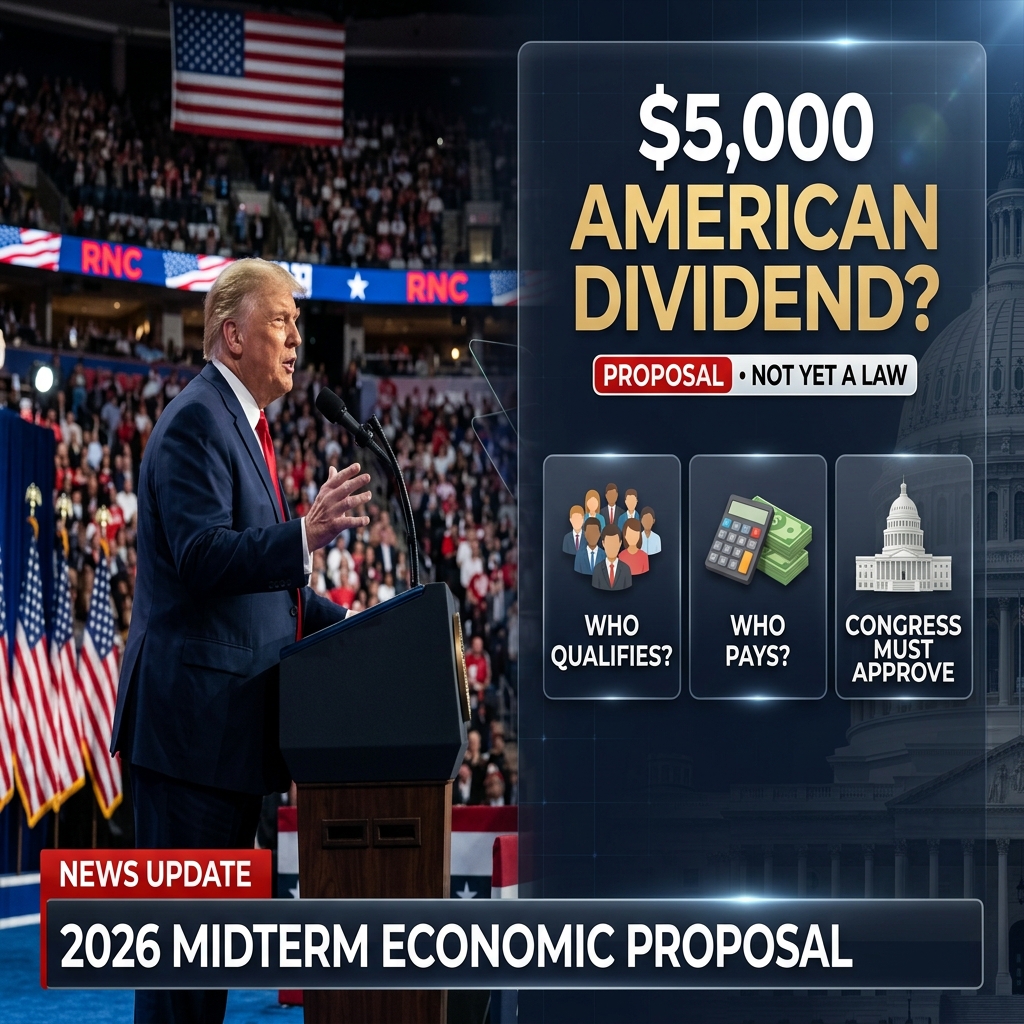
President Donald Trump has put an unusually large economic promise at the center of the 2026 midterm elections: a proposed $5,000 payment to American adults if Republicans retain control of Congress.
Trump promoted the idea during the Republican Party’s midterm convention in Dallas, presenting it as a possible “dividend” generated from money collected through tariffs.
The proposal immediately became one of the biggest political stories surrounding the convention.
It also generated a long list of questions.
How much would the program cost?
Who would qualify?
Would children receive payments?
Would wealthy Americans be excluded?
Could tariff revenue actually finance the checks?
And, most importantly, could a president create such a program without Congress?
The answer to the last question is especially important because a large-scale federal payment program would almost certainly require congressional legislation and funding.
The Size of the Proposal
A $5,000 payment sounds straightforward when viewed individually.
But the federal government has more than 200 million adults.
If payments went to roughly 200 million people, the theoretical cost could approach $1 trillion.
That is why economists and political opponents immediately questioned whether tariff revenue would be enough to cover the proposal.
Trump has argued that tariffs have generated significant revenue and that Americans could eventually benefit directly from the money.
But tariff collections are not the same thing as a guaranteed $5,000 payment fund.
The government would have to determine eligibility, establish the payment mechanism and obtain the necessary legal authority.
Why Trump Is Making the Proposal Now
The timing is clearly political.
The 2026 midterm elections are approaching, and Republicans are trying to maintain control of Congress.
Trump has repeatedly told Republicans that the midterms should be treated as a referendum on his presidency.
At the Republican convention, he urged voters to think of the election as if he himself were on the ballot.
The proposed payment therefore fits into a broader Republican campaign message focused on economic benefits for ordinary Americans.
Trump is attempting to argue that his trade policies can eventually produce direct benefits for households.
But the economy presents a difficult political environment.
Oil prices have climbed above $100 per barrel, while inflation remains a major concern.
Democrats Attack the Idea
Democrats have criticized the proposal, arguing that it is unrealistic and could amount to an election-year promise designed to influence voters.
Some Democrats have compared the proposal to a form of vote-buying.
Republicans reject that characterization and argue that Americans should benefit from government revenue generated by trade policy.
The political argument is therefore likely to continue for months.
Would Rich Americans Get the Money?
Another major question concerns eligibility.
Vice President JD Vance has suggested that the government could potentially limit payments for higher-income Americans.
But the precise rules have not been established.
That means the proposal currently functions more as a political concept than a fully designed government program.
A real federal payment would need detailed legislation specifying income thresholds, citizenship requirements, tax treatment and distribution methods.
The Tariff Problem
Trump’s proposal is connected to tariffs because tariffs generate revenue when imported goods enter the United States.
But tariffs can also increase costs for American companies and consumers.
If companies pay higher import duties, they may pass some of those costs to customers.
That creates a complicated economic calculation.
The government receives revenue, but consumers may also face higher prices.
That is why economists disagree over whether tariff revenue can effectively function as a source of household payments.
The Political Advantage
Regardless of whether the proposal becomes law, it has political value.
A simple message such as “$5,000 for Americans” is much easier for voters to understand than a complicated discussion about tariff policy.
Political campaigns thrive on simple messages.
Trump’s campaign can present the idea as a direct financial benefit.
Democrats can respond by focusing on the enormous cost and the potential impact of tariffs.
That creates a very clear political debate.
Congress Will Matter
The proposal cannot simply be implemented because the president announces it.
Congress controls federal spending.
That means lawmakers would need to approve legislation or another legally authorized mechanism.
Republicans currently control Congress, but individual Republican lawmakers could still disagree about the plan.
Some fiscal conservatives may oppose adding hundreds of billions of dollars in new spending.
Others may support the proposal because of its potential political popularity.
Why Voters Are Paying Attention
For many Americans, the question is simple: Would I actually receive $5,000?
That is why the proposal has attracted so much attention.
At a time when Americans are dealing with housing costs, food prices, gasoline prices and interest rates, a direct payment would obviously be attractive to many households.
But voters will ultimately need to distinguish between a campaign promise and an enacted government program.
Until Congress passes legislation and the administration establishes eligibility rules, there is no guaranteed $5,000 payment.
The Bigger 2026 Story
The proposal is another example of how strongly Trump is shaping the 2026 midterms around his presidency.
Republicans want voters to judge the administration by its economic policies.
Democrats want voters to focus on inflation, government spending and the consequences of Trump’s foreign and trade policies.
The $5,000 idea therefore represents more than a proposed payment.
It is becoming a symbol of the economic argument Republicans want to make heading into November.
Whether it becomes actual policy will depend on Congress, the federal budget and the administration’s ability to turn the proposal into a legally workable program.
For now, Americans should treat the $5,000 figure as a proposal—not a guaranteed check.